Your bakery is growing, but your ovens can't keep up. This production bottleneck1 is costing you time and money. You need a more efficient way to bake at scale.
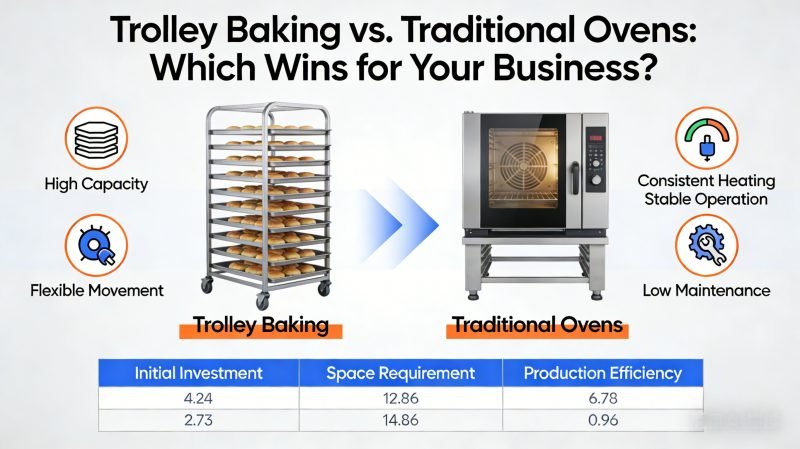
Trolley baking is the superior choice for industrial-scale operations2. It uses special heat-resistant trolleys that move from the proofer directly into a large baking room3. This combines transport and baking into one step, dramatically boosting efficiency over traditional ovens4.
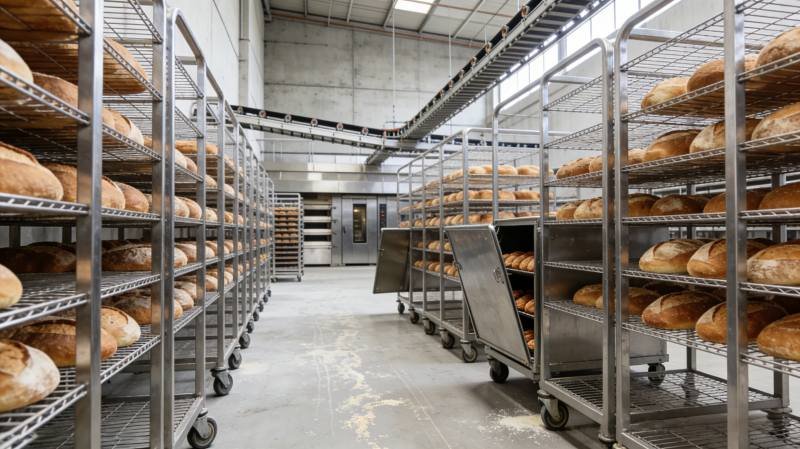
That sounds simple, but the impact on your workflow is huge. By moving an entire rack of products as one single unit, you eliminate dozens of manual steps that slow down your team and introduce inconsistencies. But this method isn't a silver bullet for everyone. So, let's explore where each baking style fits best to see which one is right for you.
When does a traditional oven make the most sense?
You run a small bakery and love your deck oven5. But as orders increase, you worry you're falling behind. Are you missing out on a more efficient method?
Traditional ovens are perfect for small to medium-sized bakeries. They give you amazing control for individual batches. They are also a good starting investment for lower production volumes, making them great for craft bakeries and local shops where quality is everything.
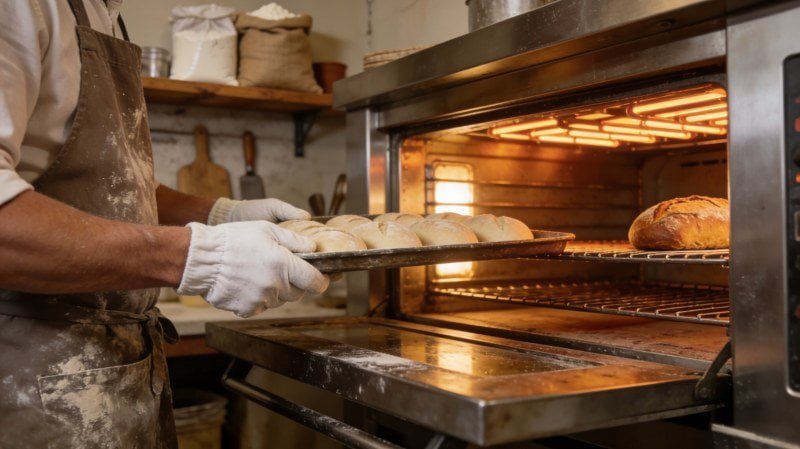
I've worked with hundreds of small bakeries, and they all start here for a reason. Traditional ovens, like deck oven5s or smaller convection oven6s, are the heart of an artisan shop. They allow a baker to give each batch personal attention. The typical workflow is very hands-on. You mix the dough, let it proof, shape it, and then load it onto trays. Then, you load those trays one by one into the oven. After baking, you unload them again. This gives you total control but creates a lot of handling. For a small shop making a few hundred items a day, this is perfectly fine. The lower initial cost is also a huge advantage when you're just starting out. Below is a simple breakdown of common traditional ovens4.
| Oven Type | Best For | Capacity | Main Advantage |
|---|---|---|---|
| Deck Oven | Artisan Breads, Pizza | Low | Intense, radiant heat from the bottom. |
| Convection Oven | Pastries, Cookies | Low-Medium | Uses a fan for fast, even baking. |
| Small Rack Oven | Various Products | Medium | Bakes a single, small rack at a time. |
The main problem with these ovens is scalability. When your business grows from a small shop to a larger supplier, this multi-step process becomes a major bottleneck. You need more staff just to move trays around, and you need more floor space for more ovens.
How does trolley baking7 dramatically boost efficiency?
Your team is constantly running back and forth, loading and unloading ovens. This manual labor is expensive and creates chaos on your production floor8. There has to be a better way.
Trolley baking makes your entire process smooth. You load trays onto a special trolley just once. Then you roll the whole trolley into your proofer. After that, you roll it directly into a large walk-in oven. This removes many handling steps.
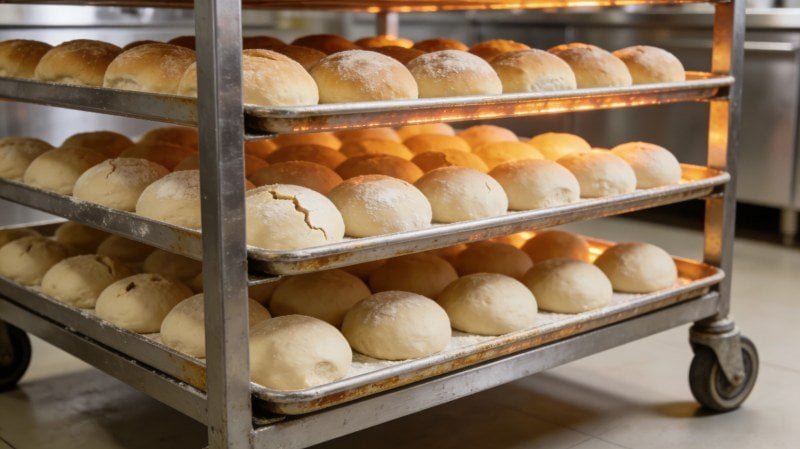
The magic of this system is its simplicity. Instead of thinking about individual trays, you start thinking in terms of "units." One trolley is one unit. This unit can hold, for example, 20 trays of bread. Your workflow changes completely. You shape your dough and place it on trays that are already on the trolley. Then, one person rolls the entire unit into the proofer. When it's ready, they roll that same unit into the baking room3 or a large roll-in oven. After baking, they roll it out to a cooling area. The product is only handled twice: once when it's placed on the tray, and once when it's taken off after cooling. This saves an incredible amount of labor and time. I remember visiting a client's large factory in Germany. They were struggling with five large deck oven5s and a team of workers just trying to keep up. After we helped them switch to a trolley baking7 system with two large baking room3s, they cut their baking labor9 by 60%. The production floor8 became calm and organized. The change was amazing.
What makes a trolley "oven-safe" and why does it matter?
You might think you can just roll any old storage trolley into a 250°C oven. That is a very bad idea. It can lead to melted wheels and a warped frame, which will ruin your products and create a serious safety risk.
An oven-safe trolley10 must be built from high-grade materials that can handle the heat. The frame should be stainless steel to prevent warping. Most importantly, the wheels must be made from special materials like phenolic resin or cast iron that won't melt at high temperatures.
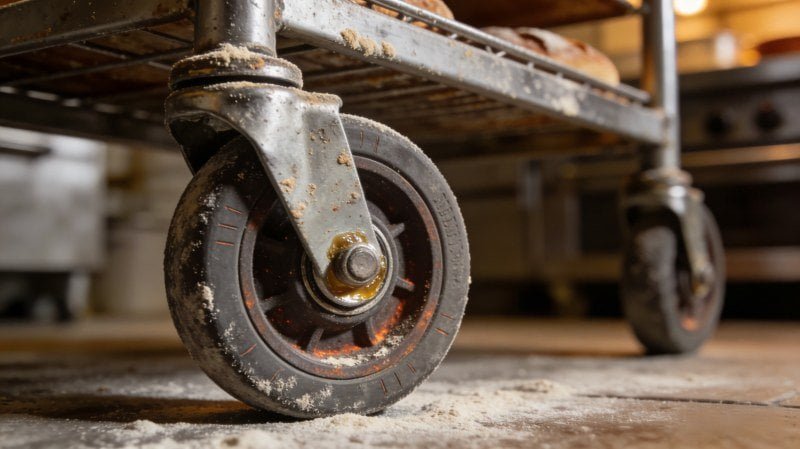
At KKbake, we focus heavily on these details because they are critical for safety and performance. A standard trolley is designed for storage and transport at room temperature. An oven-safe trolley10 is a specialized piece of industrial equipment. The frame is usually made from 304 stainless steel. This material resists warping even after hundreds of cycles of heating and cooling. The welds must also be very strong to hold the structure together under stress. But the wheels are the most common point of failure. Standard rubber or polyurethane wheels will melt, smoke, and seize up inside the oven. This can cause a trolley loaded with hundreds of pounds of product to get stuck. That’s a disaster. That’s why we use wheels made specifically for high-temperature environments. This makes the trolley more expensive, but the cost is justified. A failed trolley is not just an inconvenience; it's a production shutdown and a major safety hazard for your team.
| Component | Standard Trolley Material | Oven-Safe Trolley Material | Why it Matters |
|---|---|---|---|
| Frame | Basic Steel or Aluminum | Stainless Steel / Aluminized Steel | Prevents warping and corrosion from heat. |
| Wheels | Rubber / Polyurethane | High-Temp Phenolic / Cast Iron | Prevents melting and failure inside the oven. |
| Fasteners | Zinc-Plated | Stainless Steel | Resists weakening and corrosion under high heat. |
Is trolley baking7 better than a tunnel oven11?
You're looking for maximum efficiency and might be considering a massive tunnel oven11. But this huge investment could lock you into making only one or two products, killing your flexibility.
A tunnel oven11 offers the highest speed for a single, standardized product, like pre-packaged sandwich bread. However, a trolley baking7 system gives you much more flexibility. This makes it a smarter, more cost-effective solution for most industrial bakeries that produce a variety of goods.
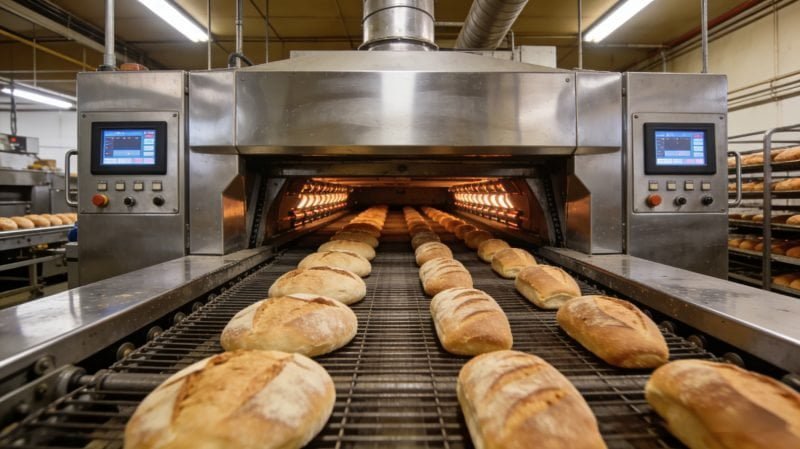
A tunnel oven11 is the king of single-task efficiency. It's basically a very long conveyor belt that moves through a tunnel with different heating zones. It’s a completely automated, continuous process. It is perfect if you need to make millions of identical items every day. But here is the problem: it is not flexible. A tunnel oven11 is designed and calibrated for one specific product. Changing it to bake something else, like moving from loaves to croissants, is either impossible or requires a massive shutdown for re-tooling. They are also incredibly expensive and take up a huge amount of space. A tunnel oven11 only makes financial sense if you are running it 24/7 at near-full capacity. In contrast, the trolley baking7 system is all about flexibility. You can have one trolley of bread rolls in one baking room3, and another trolley of pastries in a second room. You can easily adapt to changing customer orders day by day. You can also scale up your production gradually. You can start with one baking room3 and add more as your business grows. The trolley itself is a multi-purpose tool—it’s used for transport, proofing, baking, and cooling. This makes it an extremely cost-effective asset.
Conclusion
For growing bakeries, trolley baking7 offers the best balance of efficiency, flexibility, and cost. It streamlines your entire production, saving you significant time, space, and labor.
Learn strategies to overcome production bottlenecks and enhance your bakery's output. ↩
Gain insights into the complexities of managing large-scale baking operations. ↩
Discover how to design an efficient baking room layout for optimal workflow. ↩
Discover why traditional ovens are favored by small bakeries for their unique benefits. ↩
Understand the mechanics and advantages of using a deck oven in baking. ↩
Find out how convection ovens can improve baking results with even heat distribution. ↩
Explore how trolley baking can revolutionize your bakery's efficiency and workflow. ↩
Explore best practices for creating an efficient and organized production floor. ↩
Learn effective strategies to minimize labor costs while maintaining quality. ↩
Learn about the critical features that ensure a trolley is safe for high-temperature baking. ↩
Evaluate the benefits and drawbacks of tunnel ovens for high-volume production. ↩