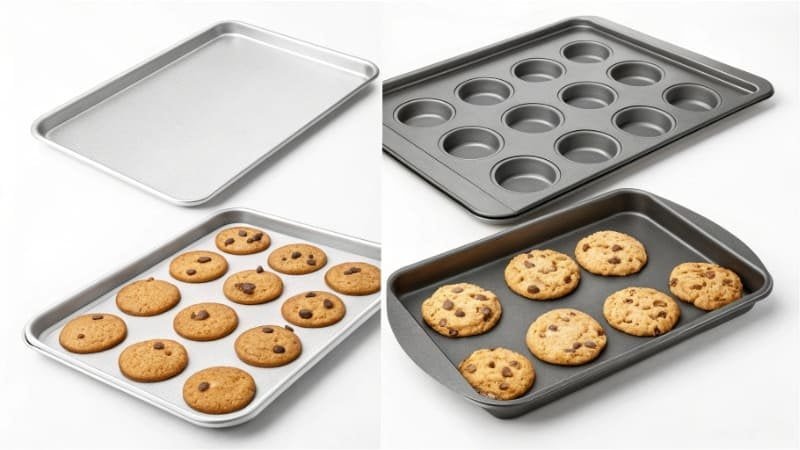
Are your cookies sticking or baking unevenly? This can ruin a whole batch and waste your time. The right baking tray1 is the simple solution for perfect results.
For home baking, lightweight aluminum alloy trays2 are excellent for their fast heating. For commercial kitchens3, durable aluminized carbon steel4 is superior for even baking. For intricate designs5, flexible silicone trays6 are the best choice to prevent breakage. Each material offers distinct advantages for perfect cookies.
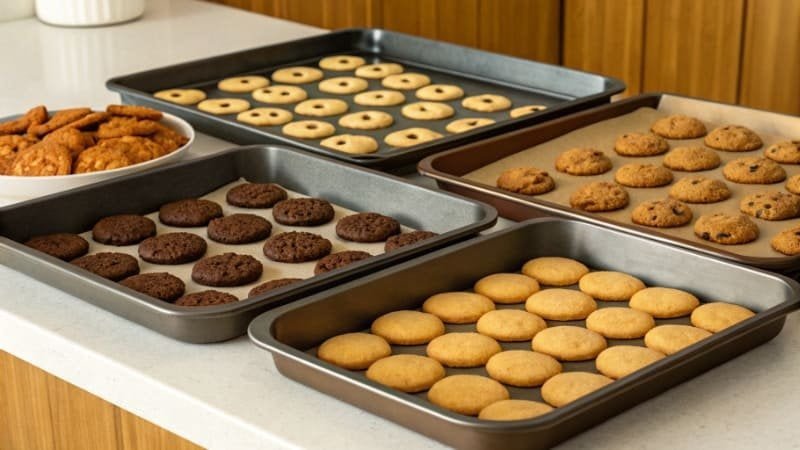
Choosing the right tray seems simple, but it's a real game-changer for your baking. The material directly affects how your cookies turn out, from their color to their texture. Let's break down why each type works best for different situations, so you can pick the perfect one for your kitchen.
Is an aluminum alloy tray the right choice for your home kitchen?
Do your homemade cookies bake unevenly? Some get burnt while others stay raw. An aluminum alloy tray's fast heat conduction7 can solve this common problem for good.
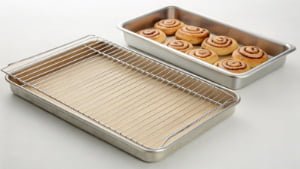
Yes, aluminum alloy trays2 are fantastic for home bakers. They are lightweight, affordable, and heat up very quickly, which helps ensure an even bake across the entire batch. For cookies with high-fat content, choose one with a non-stick coating8 for easy release every time.
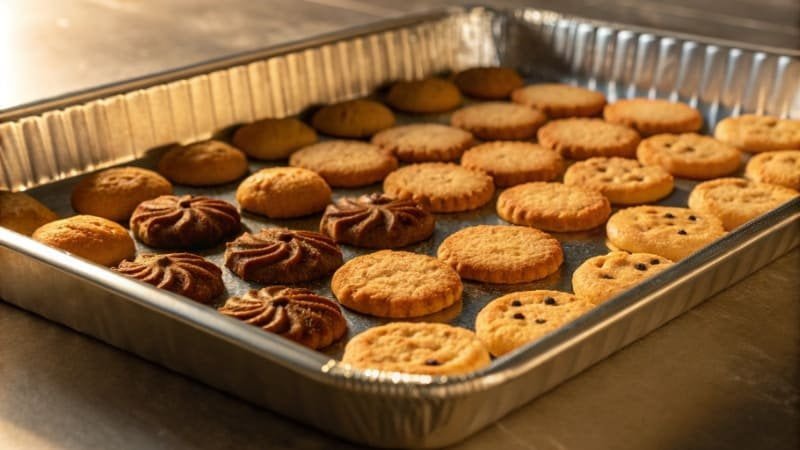
When you're baking at home, you want something reliable and easy to use. That's where aluminum alloy trays2 shine. Their main benefit is excellent heat conduction7. This means the tray heats up fast and distributes that heat across the surface, helping your cookies bake uniformly. I've found this prevents the dreaded "burnt bottom, raw middle" issue. However, you need to be careful. I remember a client who used very thin aluminum loaf pans in their small factory. The constant high heat caused severe warping, which became a huge headache for their production. So, always choose a thicker, sturdier tray. For cookies with a lot of butter or oil, a non-stick coating8 is a great help. It’s usually a Teflon coating that allows cookies to slide right off. Just remember not to use metal spatulas or knives on it, as you can easily scratch and damage the surface.
Key Features of Aluminum Alloy Trays
| Feature | Benefit / Consideration |
|---|---|
| Heat Conduction | Excellent. Heats up fast and cools down quickly. |
| Weight | Lightweight and very easy to handle in a home kitchen. |
| Durability | Can warp at very high temperatures, especially if the tray is thin. |
| Coating | A non-stick option is great for sticky doughs, but be gentle with it. |
| Best For | General home cookie baking9 and everyday use. |
Are you seeing inconsistent product quality in large batches? This wastes a lot of ingredients and money. Aluminized carbon steel trays offer the durability11 and consistency needed for mass production.
Factories choose aluminized carbon steel4 for its amazing strength and superior heat distribution. The carbon steel core provides perfectly even baking, while the aluminum coating adds durability11 and corrosion resistance. A non-stick layer is crucial for fast, easy demolding, which cuts down on labor costs.
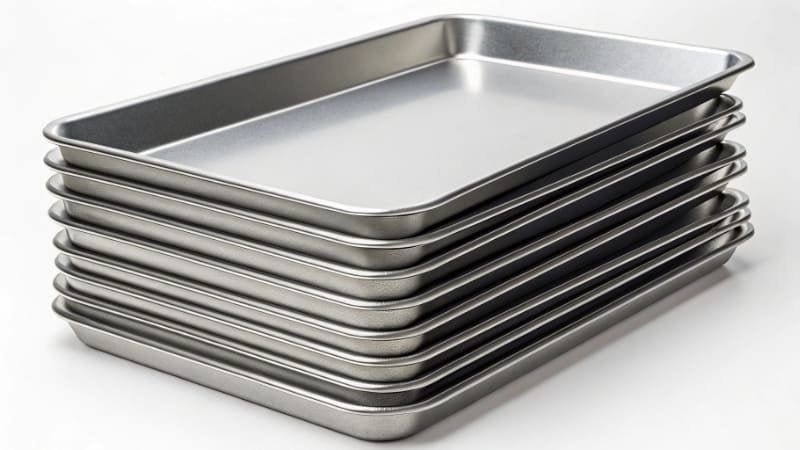
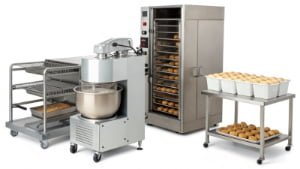
In a commercial setting, equipment has to be tough and efficient. That’s why professional bakeries and food factories depend on aluminized carbon steel4 trays. These trays are built differently. They have a heavy-duty carbon steel core, which is fantastic for holding and distributing heat evenly. This means every cookie on a tray bakes at the same rate, ensuring consistency across thousands of units. The steel is then coated with an aluminum-silicon alloy. This coating protects the steel from rust and makes it resistant to the high temperatures of industrial ovens. The result is a tray that lasts a very long time, even with constant use. Most importantly for factories, these trays come with a non-stick coating8. Imagine having to demold thousands of cookies a day by hand. A good non-stick surface makes this process incredibly fast and reduces the need for extra labor, which is a huge cost saving.
Why Professionals Choose Aluminized Carbon Steel
| Aspect | Details |
|---|---|
| Core Material | Carbon steel ensures even heat distribution for consistent results batch after batch. |
| Coating | The aluminum coating enhances heat resistance and prevents corrosion over time. |
| Durability | Built to withstand constant, heavy use in a high-temperature factory environment without warping. |
| Efficiency | A non-stick surface allows for quick release, which dramatically improves production speed12. |
| Best For | High-volume, commercial cookie production where consistency is key. |
Do your beautifully shaped cookies break when you try to remove them? All that detailed work gets ruined in an instant. A flexible silicone tray lets you pop them out perfectly.
You should use a silicone tray for cookies with intricate, complex shapes that are difficult to demold. Its soft, flexible material allows you to release delicate cookies without any damage. This makes it ideal for both home bakers and factories producing specialty items with unique designs.
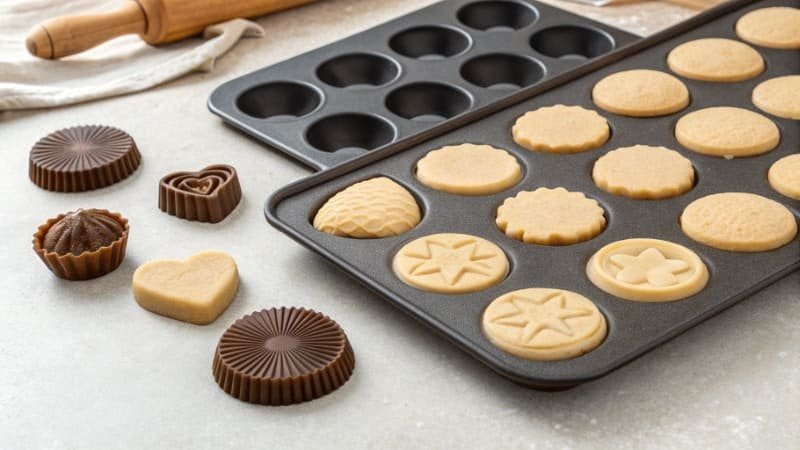
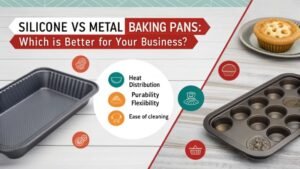
Silicone trays have a very specific and valuable use. They are perfect for those times when the shape of the cookie is the most important thing. Think of detailed holiday cookies or character shapes that have thin, delicate parts. With a metal tray, these bits can stick and break off when you try to lift them. With silicone, you can just bend the tray and gently push the cookie out from the bottom. It’s a lifesaver for preserving complex designs. Another plus is storage; you can roll them up or fold them to save space. However, there are downsides. Silicone is not a great heat conductor, so cookies take longer to bake and don't get as brown on the bottom. Cleaning can also be tricky, as oils tend to cling to the surface. And you must make sure the tray is completely dry before storing it, because any leftover moisture can lead to mold growth.
Pros and Cons of Silicone Baking Trays
| Feature | Pro | Con |
|---|---|---|
| Flexibility | Excellent for demolding complex shapes without breakage. | Can be flimsy; needs to be placed on a firm sheet. |
| Heat Transfer | Naturally non-stick. | Slower to heat, resulting in less browning and longer bake times. |
| Cleaning | Generally dishwasher safe. | Can be difficult to remove grease. Must be dried completely. |
| Storage | Can be bent or rolled up for very compact storage. | - |
| Best For | Intricately shaped cookies that are prone to breaking. |
Conclusion
Choosing the right cookie tray depends on your needs. Use aluminum for home, steel for factories, and silicone for special shapes. This simple choice makes a big difference.
Discover the best baking trays for home use and how they can improve your baking results. ↩
Explore the advantages of aluminum alloy trays for home baking, including their heat conduction and lightweight nature. ↩
Explore the essential baking equipment used in commercial kitchens for efficiency and quality. ↩
Learn why aluminized carbon steel is favored in commercial kitchens for its durability and even baking. ↩
See how silicone trays are ideal for baking cookies with complex shapes and designs. ↩
Discover how flexible silicone trays can help preserve intricate cookie designs and ease demolding. ↩
Understand the importance of heat conduction in baking and how it influences cookie texture and color. ↩
Find out how a non-stick coating can make baking and cleanup easier, especially for sticky doughs. ↩
Learn the best practices for baking cookies to achieve perfect results every time. ↩
Learn about the methods cookie factories use to maintain consistency and quality in large batches. ↩
Explore the durability of aluminized carbon steel trays and their ability to withstand high temperatures. ↩
Discover how non-stick surfaces can enhance production speed and efficiency in baking. ↩