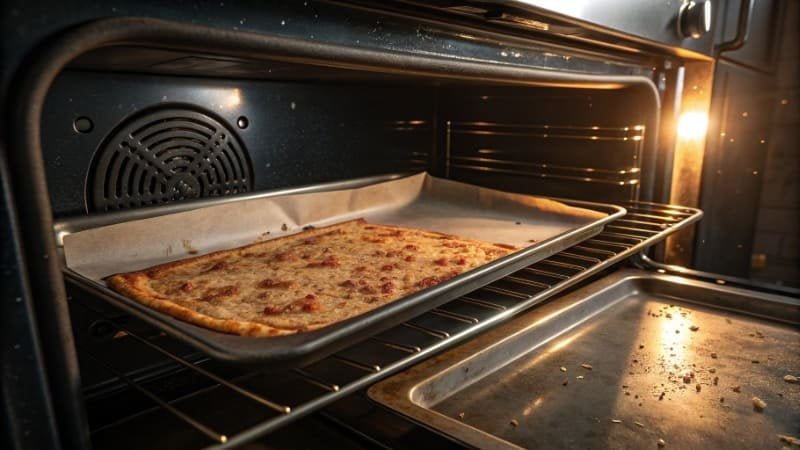
Ever hear a loud "BANG" from your oven and panic? It's likely your baking sheet warping1. This is frustrating and can ruin your bake. But what if it's completely preventable?
A baking sheet warps due to thermal shock2, which is a rapid and uneven change in temperature. The metal expands too quickly in some spots and not others, causing it to bend. Using thicker pans3 made from materials like aluminized steel4 helps prevent this by distributing heat more evenly.
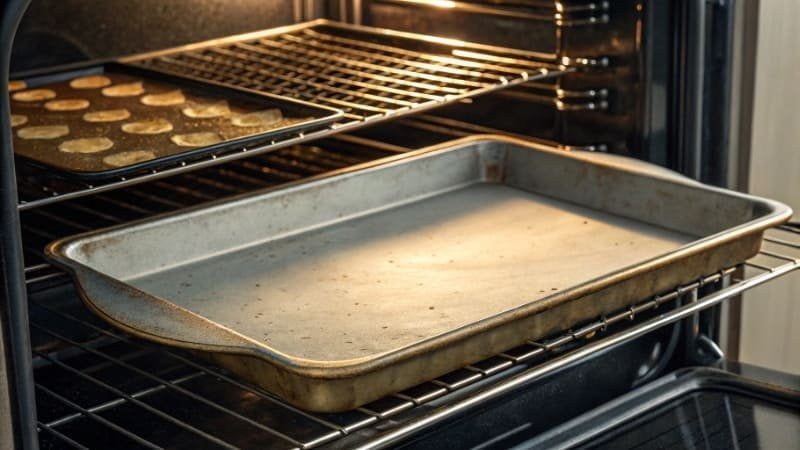
That startling sound is more than just an annoyance. It's a sign that your bakeware is under a lot of stress. When a pan warps, it can lead to unevenly cooked food5, with some parts burnt and others underdone. It's a common problem, but one that you can solve. Understanding the science behind it is the first step to choosing the right pan for the job. So let's look at the materials and see what makes the best choice for your bakery or kitchen.
Are some baking sheet materials6 more prone to warping than others?
You buy baking sheets, and some last for years while others warp on the first use. It feels like a waste of money. The secret isn't luck; it's the material.
Yes, absolutely. Thin, pure aluminum or aluminum alloy7 sheets are very prone to warping. Heavier-gauge aluminum and aluminized steel4 are far more resistant. Their thickness and strength help them handle high heat8 and distribute it evenly, which is the key to staying flat in the oven.
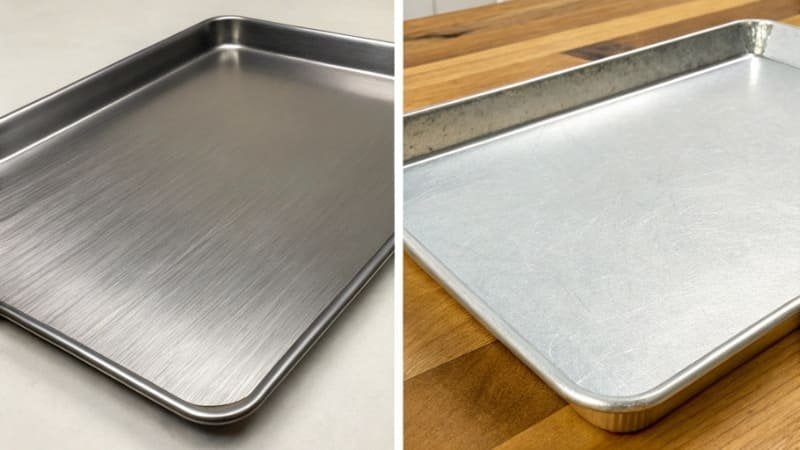
When we talk about bakeware, the material it's made from is everything. The main issue is something called thermal expansion9—all metals expand when heated. The problem starts when they expand unevenly. This is where material choice becomes critical.
Aluminum Alloy vs. Aluminized Steel
Aluminum is a fantastic heat conductor, which is why it's so popular for bakeware. It heats up fast. However, pure aluminum and many aluminum alloy7s are also very soft and have a high rate of thermal expansion9. In thin sheets, this makes them warp very easily under heat. They simply don't have the structural strength to resist the stress.
Aluminized steel, on the other hand, offers the best of both worlds. It has a strong steel core, which provides rigidity and durability. This core is then coated with an aluminum-silicon alloy. This coating gives the pan excellent heat conductivity10 and protects the steel from rust. The strong steel core provides the muscle to resist bending and warping, even at high commercial-oven temperatures.
| Material | Heat Conduction | Warp Resistance | Durability | Best For |
|---|---|---|---|---|
| Aluminum Alloy | Excellent | Low to Medium | Medium | Home baking, lightweight needs |
| Aluminized Steel | Very Good | High | Excellent | Commercial bakeries, high-heat use |
| Stainless Steel | Fair | Very High | Very High | Niche uses, slow heating |
A Lesson We Learned the Hard Way
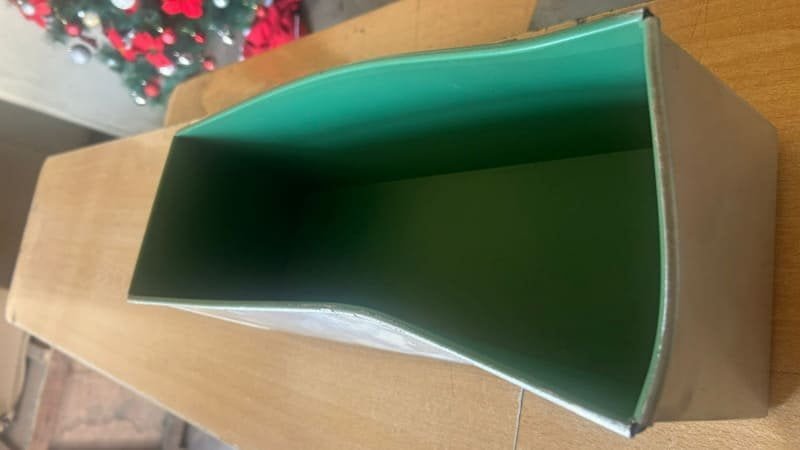
I remember a tough lesson we learned a few years back. I can still picture the email from our Chilean client. He was a new customer we met at a trade show, and this was our first trial order—a big batch of large loaf pans with lids. He specifically requested them to be lightweight. To meet this, we chose an aluminum alloy7. For a standard pan, this might have been fine. But these pans were huge. At the time, we were so focused on the weight that we overlooked structural integrity. We just didn't have enough experience with that specific large dimension. A few weeks after delivery, the feedback came in. The lids were warping badly, some to the point where they were unusable. It was a clear failure on our part. We learned that for large surface areas, the strength of aluminized steel4 is non-negotiable, even if it adds a little weight. We issued a partial refund since shipping them back was impractical. It was a costly mistake, but it fundamentally shaped our design philosophy. Now, strength and warp resistance11 are always our top priorities, especially for our professional clients who depend on durability day in and day out.Below are the images provided by the customer.
Does the thickness of the baking sheet really matter?
You see baking sheets labeled with different "gauges," and it's confusing. Choosing the wrong one means you're back to square one with warped pans and wasted money. It's actually simple.
Absolutely. The thickness, or gauge, is one of the most critical factors in preventing warping. A thicker pan (which has a lower gauge number12) has more structural integrity. This allows it to heat more evenly and resist the physical stress of expansion much better than a thin pan.
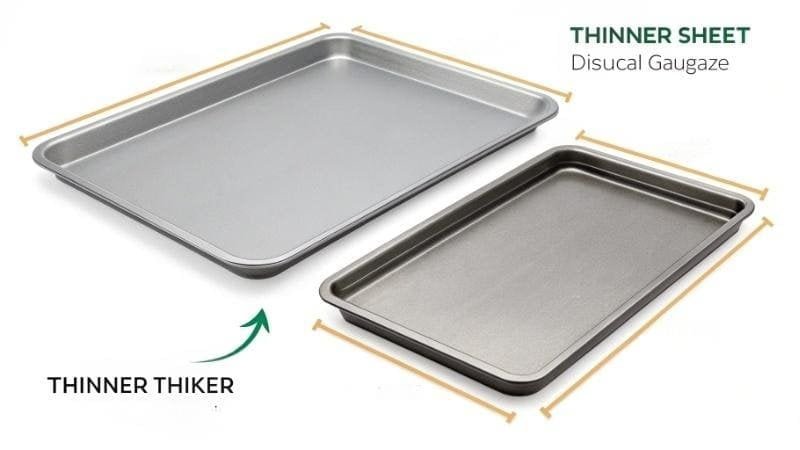
It might seem like a small detail, but the thickness of your baking sheet has a huge impact on its performance and lifespan. In the metal industry, we measure thickness using a standard called "gauge." It can be a little confusing at first because the system is inverted.
Understanding Metal Gauge
The most important thing to remember is this: a lower gauge number12 means a thicker and stronger piece of metal. So, a 16-gauge steel sheet is much thicker and more robust than a 22-gauge sheet. When you're shopping for bakeware, a lower gauge number12 is a sign of higher quality and better durability.
Why Thickness Prevents Warping
Think of it like a thin sheet of paper versus a thick piece of cardboard. The paper bends and folds with the slightest force. The cardboard, however, is rigid and holds its shape. Metal works in a similar way. A thicker baking sheet has more internal strength to resist the bending forces created when different parts of the pan expand at different rates. It also has more mass, which means it absorbs and distributes heat more slowly and evenly. This gentle, even heating process dramatically reduces the thermal "shock" that causes a pan to warp with a loud bang. For our large-scale industrial clients running tunnel ovens, we almost exclusively recommend heavy 12 or 14-gauge aluminized steel4. Their lines run constantly, and they can't afford downtime because a pan buckled. For a chain bakery, a 16 or 18-gauge pan is often the sweet spot. It's durable enough for heavy daily use but not as heavy or expensive as the top industrial-grade options.
Practical Gauge Recommendations
For a startup bakery or a serious home baker, an 18-gauge pan is a fantastic investment that will last for years. The thin, 20 or 22-gauge pans you find in many big-box stores are really only suitable for occasional, low-temperature baking. Trying to roast vegetables at high heat8 on one of those is just asking to hear that familiar, frustrating noise from your oven.
| Gauge | Thickness (Approx.) | Best For | Warp Resistance |
|---|---|---|---|
| 20-22 | 0.8-0.9mm | Light home use, cookies | Low |
| 18 | ~1.2mm | Serious home bakers, light commercial | Medium |
| 16 | ~1.5mm | Commercial bakeries, high-volume | High |
| 12-14 | ~2.0-2.6mm | Heavy industrial use | Very High |
Can how I use my baking sheet cause it to warp?
You bought a heavy-duty pan13, but it still warped. What went wrong? It's frustrating to invest in good equipment only to have it fail. Your habits might be the real culprit.
Yes, your usage habits play a huge role. Drastic temperature changes14 are the primary enemy. Placing a cold pan in a preheated oven, putting frozen food on just one side of a hot pan, or running a hot pan under cold water will almost guarantee warping.
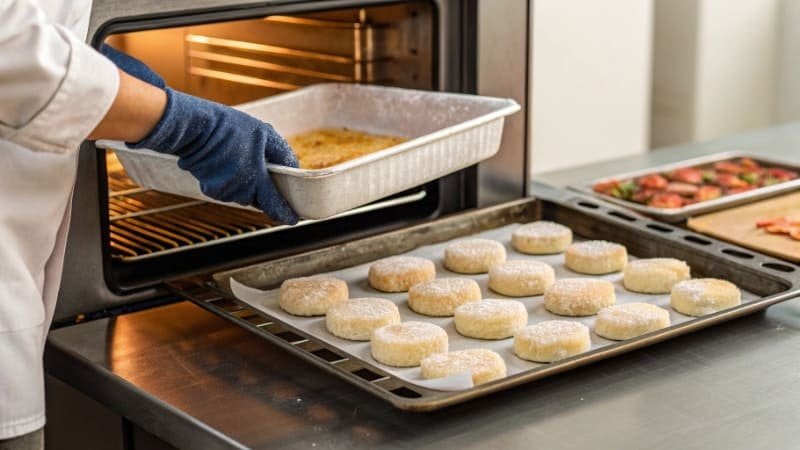
Even the best, most expensive baking sheet can be ruined by improper use. The enemy is always thermal shock2. Understanding what causes it can help you protect your investment and ensure your pans last for a very long time.
The Science of Thermal Shock
Think of a bridge in winter. If one side is in the sun and the other is in the freezing shade, the sunny side expands while the shady side contracts. This creates enormous stress on the structure. Your baking sheet is like that bridge. When you place a handful of frozen items on one half of a hot pan, you're creating a massive temperature difference across the metal. The hot, empty side wants to expand, while the cold side under the food wants to stay put. The metal has to give somewhere, and that's when it bends to release the tension. This process is what creates that sudden "BANG!" you hear from the oven.
Common Mistakes to Avoid
Here are the most common habits that destroy baking sheets:
- Uneven Food Placement: Spreading food evenly helps the pan heat evenly. Placing a small amount of frozen food on one corner of a large, preheated pan is a recipe for disaster. The empty parts get very hot, very fast, while the part under the food stays cool. This extreme temperature difference is a primary cause of warping.
- Drastic Temperature Swings: Never take a pan from the freezer and put it directly into a hot oven. Let it rest at room temperature for a few minutes first. And most importantly, never put a hot pan from the oven into a sink of cold water. The rapid contraction of the metal will almost certainly warp it, and in some extreme cases, it can even cause micro-fractures in the material.
Best Practices for Pan Longevity
To make your pans last, always try to heat and cool them gradually. Using a liner like parchment paper or a silicone mat can help, as it acts as a slight insulator and helps buffer the direct contact between the food and the metal. Most importantly, always let your pans cool down on a rack for several minutes before you attempt to wash them.
Conclusion
Choosing the right material and thickness is key. But proper use and care will truly make your baking sheets last. Avoid thermal shock2 to prevent warping and keep on baking.
Understanding the causes of warping can help you choose the right bakeware and avoid frustrating kitchen mishaps. ↩
Learn about thermal shock to prevent damage to your bakeware and ensure even cooking results. ↩
Discover the advantages of using thicker pans for better heat distribution and less warping. ↩
Discover why aluminized steel is a top choice for durability and heat distribution in baking. ↩
Understanding the causes of uneven cooking can help you improve your baking techniques. ↩
Explore various baking sheet materials to find the best options for your baking style. ↩
Find out how aluminum alloy affects the performance and longevity of your baking sheets. ↩
Learn how different materials perform under high heat to choose the best bakeware for your recipes. ↩
Understanding thermal expansion can help you choose the right materials for your bakeware. ↩
Explore how heat conductivity impacts baking performance and the quality of your baked goods. ↩
Discover the importance of warp resistance for maintaining the shape and performance of your bakeware. ↩
Understanding gauge numbers can help you select the right thickness for your baking needs. ↩
Find out the benefits of using heavy-duty pans for serious baking tasks. ↩
Learn how to manage temperature changes to prolong the life of your baking sheets. ↩