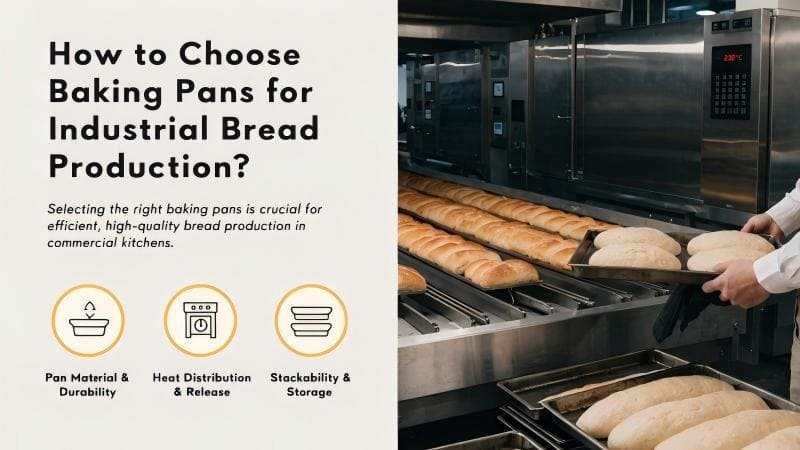
Your production line grinds to a halt because of warped pans. This downtime costs you money and creates massive headaches. Choosing the right baking pans from the start prevents these problems.
For industrial bread production, the best choice is an aluminized steel pan with a professional-grade non-stick coating. This combination offers superior durability, warp resistance, and easy cleaning. It is perfectly suited for automated lines, providing the best long-term value and operational reliability for your factory.1
That’s the short answer. But as a factory manager or purchasing director, you know the details are what truly matter. The wrong choice can cost you thousands in replacements and lost production time. So, let's break down exactly why this specific combination is the industry standard and how to identify the right features for your specific needs. Understanding these details will help you make a smart investment that pays off for years.
Why Is Aluminized Steel the Best Material for Industrial Baking Pans?
Choosing between aluminum and steel for your pans feels like a big decision. The wrong material leads to warped pans, wasted dough, and constant replacements. But one material clearly outperforms the other for the heavy demands of industrial use.
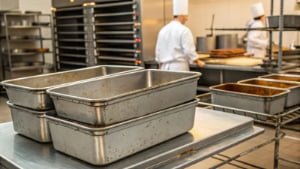
Aluminized steel is the best material because it combines the strength of steel with the corrosion resistance and heat transfer of aluminum. This makes it incredibly durable and warp-resistant, which is perfect for high-volume, automated production lines. It ensures a long lifespan and consistent performance.
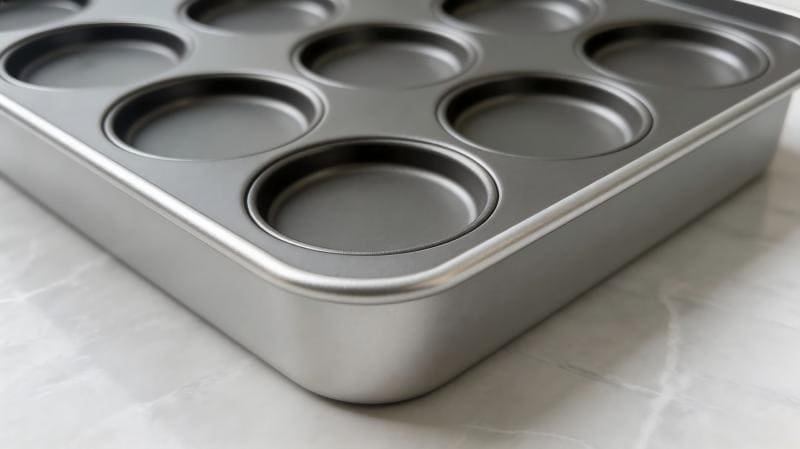
Over my years in this business, I've seen many factory managers try to save a little money upfront by choosing pure aluminum pans. The problem is, aluminum just isn't strong enough for the non-stop cycle of an industrial bakery. It deforms easily under heat and the stress of automated handling.2 Some think the solution is to just use thicker aluminum. But that increases the cost and makes the pan almost as heavy as an aluminized steel one, defeating the purpose.
Honestly, the extra weight of aluminized steel is a feature, not a flaw. A heavier pan is a stronger pan.3 It sits more securely on conveyor belts and resists bending and warping after thousands of baking cycles. It means you are buying a tool built to last. I always tell my clients, like Klaus in Germany who runs a huge frozen dough plant, that aluminized steel is a "buy it right, buy it once" solution. It saves you money in the long run by reducing the need for replacements.
Here is a simple breakdown:
| Feature | Aluminized Steel | Pure Aluminum |
|---|---|---|
| Durability | Excellent | Fair |
| Warp Resistance | High | Low |
| Weight | Heavier | Lighter |
| Cost | Moderate | Moderate (if thick) |
| Automation Suitability | Excellent | Good (but deforms) |
| Lifespan | Very Long | Shorter |
What Makes a Non-Stick Coating Truly 'Industrial-Grade'?
Your non-stick coating is peeling after just a few months of use. This leads to stuck bread, difficult cleaning, and serious food safety risks. Not all coatings are created equal, and industrial bakeries need a specific level of quality.
An industrial-grade non-stick coating, like a professional Teflon, is designed to endure thousands of baking cycles. It must handle high temperatures, thermal shock, and abrasive cleaning. Its main features are excellent release properties, extreme durability, and a certified food-safe composition for professional use.
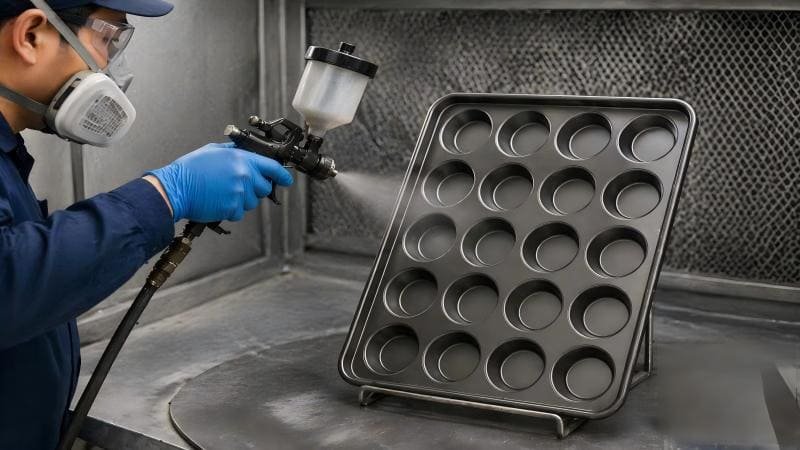
The secret to a great coating isn't just the material itself, but how it's applied. A cheap, single-layer spray-on coating will fail quickly. For industrial use, we rely on a multi-layer system. We start by preparing the pan's surface to ensure the coating bonds perfectly. Then, we apply several layers, each cured at high temperatures. This process creates a coating that is tough, long-lasting, and can handle the thermal shock of going from a freezer to a 250°C oven4, day after day.
This durability is critical for clients like BakeStar GmbH, whose frozen products demand pans that can withstand extreme temperature changes without the coating blistering or peeling. A quality coating also makes cleaning simple and fast. This reduces labor costs and helps you meet strict hygiene standards like HACCP.5 While Teflon is a great all-around choice for bread, we can also use other specialized coatings. For example, a silicone glaze works better for products with very high sugar content. The right coating depends on your product, but it must always be industrial-grade.
Key Coating Characteristics to Look For
- Multi-Layer Application: Ensures a stronger bond and longer life.
- High-Temperature Resistance: Must withstand your oven's maximum temperature without degrading.
- Food-Safe Certification: Always ask for proof of compliance with food contact regulations.
- Excellent Release: Products should slide out with minimal effort, reducing damage and cleaning time.
How Does Pan Design Impact Automation and Efficiency?
You've just received a shipment of new pans, but they don't fit your automated de-panner correctly. This causes jams on the line, damages your bread, and brings production to a complete halt. The right pan is designed specifically for your automated system.
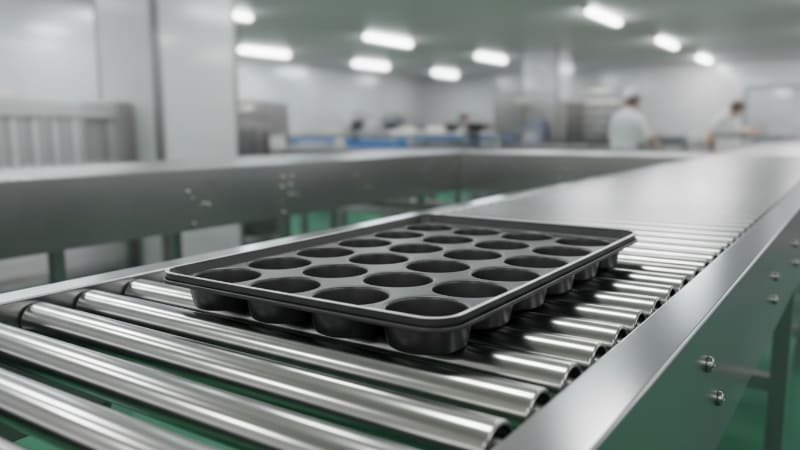
Pan design is critical for automation. It requires precise dimensions with very tight tolerances, reinforced edges to prevent bending, and options for custom frames that work with your stackers, de-panners, and conveyors. A well-designed pan ensures smooth, uninterrupted production with minimal manual work.
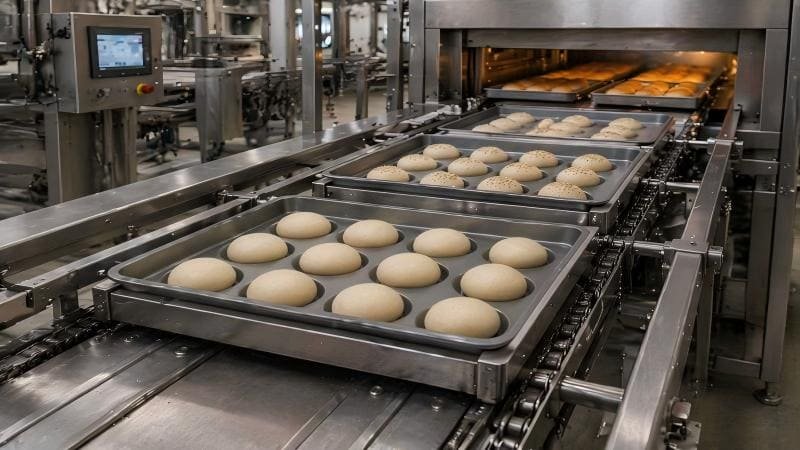
When we talk about industrial pans, we are really talking about custom-engineered equipment. It’s not an off-the-shelf product. For factories with automation, we often weld custom steel frames around the baking pans.6 These frames give the machinery a consistent, sturdy surface to grab, lift, and move. This is something you simply cannot do effectively with a flimsy pan.
The dimensions have to be perfect. A client like Klaus Weber requires a tolerance of less than 1mm across a large pan.7 Any more than that, and the pans can get stuck in the machinery. At KKbake, we use CNC machines and laser cutters to guarantee this level of precision. We also reinforce the rims of our pans, often by rolling a steel wire into the edge. This small detail makes a huge difference in preventing the pan from bending or getting damaged when handled by machines or even dropped. It’s another reason why aluminized steel is the superior choice—it's strong enough to support these essential design features. A heavy, stable, and precisely made pan is the key to a smooth and efficient automated bakery.
Essential Design Features for Automation
- Custom Frames: Allow seamless integration with robotic stackers and de-panners.
- Reinforced Rims: Prevent warping and damage from handling.
- Precise Dimensions: Ensure a perfect fit in your machinery, eliminating jams.
- Stacking Lugs: Allow pans to be stacked securely without damaging the pan below.8
Conclusion
For industrial baking, choose aluminized steel pans with a quality coating and a design customized for your line. This is the smart investment for long-term efficiency and profitability.
"The Benefits and Uses of Aluminized Steel", https://www.blocksteel.com/the-benefits-and-uses-of-aluminized-steel. Sources that survey industrial bakeware materials and industrial kitchen practice can be cited to support that aluminized steel plus professional non-stick coatings are commonly recommended for durability, warp resistance, and cleanability in high-volume baking; such sources typically describe comparative advantages but may not quantify ‘best’ for every specific line or product type. Evidence role: general_support; source type: encyclopedia. Supports: For industrial bread production, the best choice is an aluminized steel pan with a professional-grade non-stick coating. This combination offers superior durability, warp resistance, and easy cleaning. It is perfectly suited for automated lines, providing the best long-term value and operational reliability for your factory.. Scope note: Most sources provide comparative descriptions and guidelines rather than a single universal 'best' choice for all factories; suitability can depend on product, oven type, and handling systems. ↩
"[PDF] mechanical properties of metals and alloys", https://nvlpubs.nist.gov/nistpubs/Legacy/circ/nbscircular447.pdf. Engineering and materials guidance on aluminum cookwares and trays indicate that aluminum has lower yield strength and higher thermal expansion than steel, which can make thin aluminum sheets more prone to bending and permanent deformation under repeated mechanical and thermal stress; such sources support the mechanism by which thin aluminum pans may deform in heavy industrial use. Evidence role: mechanism; source type: education. Supports: Aluminum's lower yield strength and higher thermal expansion compared with steel explain why thin aluminum pans can deform under repeated thermal and mechanical stress in industrial settings.. Scope note: Empirical deformation depends on alloy, temper, thickness, and design details; statements about 'isn't strong enough' are contextual to thin-sheet constructions used in industrial baking rather than all aluminum alloys. ↩
"[PDF] 3. STRENGTH AGAINST BENDING - UPCommons", https://upcommons.upc.edu/bitstreams/152f6602-e337-44dc-af73-0edc1663b0a7/download. Mechanical engineering principles and simple beam/bending theory indicate that increased cross-sectional area and moment of inertia (often corresponding to greater mass or thickness) increase rigidity and resistance to bending; such sources explain why heavier/thicker pans are less prone to deflection under load. Evidence role: mechanism; source type: education. Supports: Basic structural mechanics support that increased thickness (often increasing weight) raises rigidity and resistance to bending in sheet metal components such as pans.. Scope note: Greater mass/weight alone is not always sufficient; actual stiffness depends on geometry and material modulus, so 'heavier equals stronger' is a useful rule of thumb but not universally precise. ↩
"Glass Kitchenware Cautions • AnswerLine • Iowa State ...", https://blogs.extension.iastate.edu/answerline/2019/03/04/glass-kitchenware-cautions/. Food engineering and bakehouse practice documents discuss thermal shock considerations when moving frozen dough directly into ovens and note typical oven temperatures (often up to ~250–260 °C) used for baking; such documents can be cited to show that equipment and coatings used in frozen-product bake-off must tolerate rapid temperature changes and specified maximum temperatures. Evidence role: statistic; source type: research. Supports: Frozen-dough bake-off workflows expose pans and coatings to rapid temperature increases (freezer to oven), and industrial ovens commonly reach ~250 °C, so coatings and substrates intended for these processes need to tolerate such thermal shock and peak temperatures.. Scope note: Operational temperatures and allowable thermal cycles vary by product and oven design; a source may give typical ranges but not guarantee all coatings tolerate every freezer-to-250°C scenario. ↩
"HACCP Principles & Application Guidelines - FDA", https://www.fda.gov/food/hazard-analysis-critical-control-point-haccp/haccp-principles-application-guidelines. HACCP guidance and food safety resources from governmental and international agencies outline requirements for equipment cleanliness and hygienic design; literature on foodservice operations can also document that easier-to-clean surfaces reduce cleaning time and associated labor, supporting the connection between cleanable equipment and HACCP implementation. Evidence role: expert_consensus; source type: government. Supports: HACCP and food-safety guidance emphasize hygienic design and cleanability of equipment; easier-to-clean pan surfaces can reduce cleaning effort and support HACCP implementation, although measured labor savings vary by operation.. Scope note: While easier-to-clean surfaces generally reduce labor and support HACCP compliance, actual labor savings and compliance outcomes depend on facility practices, cleaning protocols, and verification procedures. ↩
"Oversized Weldments Case Study - KC Robotics", https://kcrobotics.com/robotic-steel-welding-case-study/. Trade publications and bakery equipment case studies describe common practices such as reinforcing or framing pans (e.g., welded frames or rims) to provide consistent handling surfaces and increased durability when integrating with automated handling systems; such sources document that welded frames are one common engineering approach. Evidence role: case_reference; source type: research. Supports: Industry case studies and equipment guides report that welding reinforcement frames or rims onto pans is a practiced method to create sturdy handling surfaces for automated bakery equipment.. Scope note: Welding custom frames is a common practice in many operations but not the only solution; some systems use clip-on frames, molded rims, or machine modifications instead. ↩
"Design of a one-shot FDM-printed adaptive robotic gripper with rigid ...", https://www.sciencedirect.com/science/article/pii/S0957415826000309. Automation and precision-handling literature (robotics, conveyor indexing, and fixture design) discusses the typical positional and part-tolerance requirements for reliable automated gripping and guidance; these sources can be used to show that sub-millimeter to millimeter-level tolerances are often necessary for high-speed automated material handling, though exact figures depend on machinery. Evidence role: statistic; source type: education. Supports: Automation engineering references indicate that many automated gripping and conveying systems require part tolerances on the order of ~1 mm or better to avoid jams and ensure repeatable handling, supporting the article's claim that tight tolerances matter for pans.. Scope note: A specific '<1 mm' tolerance requirement for large pans is operation- and machine-dependent; sources may provide typical ranges rather than a single universal tolerance. ↩
"Are stacked pans safe when not in use? - Facebook", https://www.facebook.com/groups/cookingwithhexclad/posts/1800628877424210/. Bakery equipment design guides and manufacturer technical descriptions commonly describe stacking lugs (or stacking lips) as a feature that spaces and supports pans during stacking to prevent rubbing and damage to underlying pans; such descriptions support the functional claim about stacking lugs. Evidence role: definition; source type: other. Supports: Technical descriptions of pan design list stacking lugs as a feature intended to enable secure stacking while minimizing contact damage between pans.. Scope note: Descriptions of stacking lugs explain their intended function, but the effectiveness in reducing damage depends on lug design, stacking method, and load handling practices. ↩