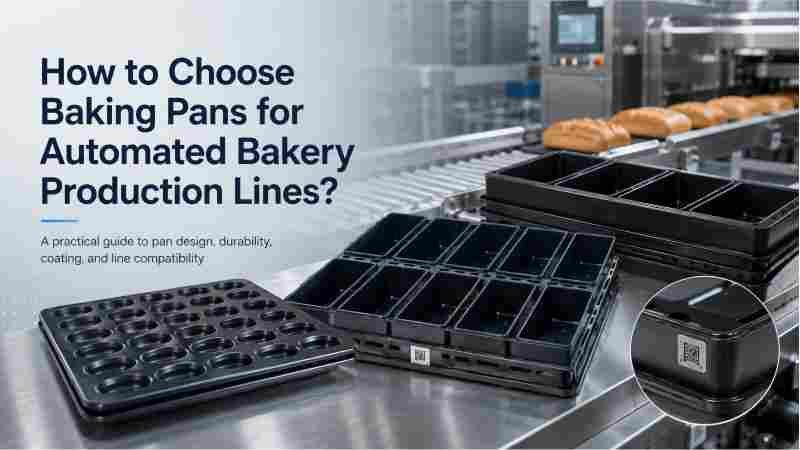
Struggling with production line jams and inconsistencies? These disruptions cost you time and money, but the right baking pans, designed for automation, can create a seamless and efficient workflow.
For an automated bakery line, choose pans made from aluminized steel with custom features. These include special frames to fit robotic arms and tunnel ovens, designs that allow for easy stacking, and traceability codes like Data Matrix for quality control. This ensures durability, efficiency, and process control.
Choosing the right pan is about more than just getting the right size. It's about investing in a tool that integrates perfectly with your entire automated system. A standard pan can cause endless problems, while a custom-designed one can unlock new levels of efficiency. Let's break down the key features you need to consider for a perfectly smooth operation.
Why is Aluminized Steel the Best Choice for Industrial Baking?
Are your current baking pans warping, rusting, or causing uneven bakes? This leads to frequent replacements and inconsistent product quality, eating into your profits and hurting your brand's reputation.
Aluminized steel is the ideal material because it combines the strength of steel with the superior heat conductivity and corrosion resistance of aluminum.1 This makes it incredibly durable, efficient, and perfect for the high-volume, high-temperature demands of an automated baking environment, ensuring a long service life.
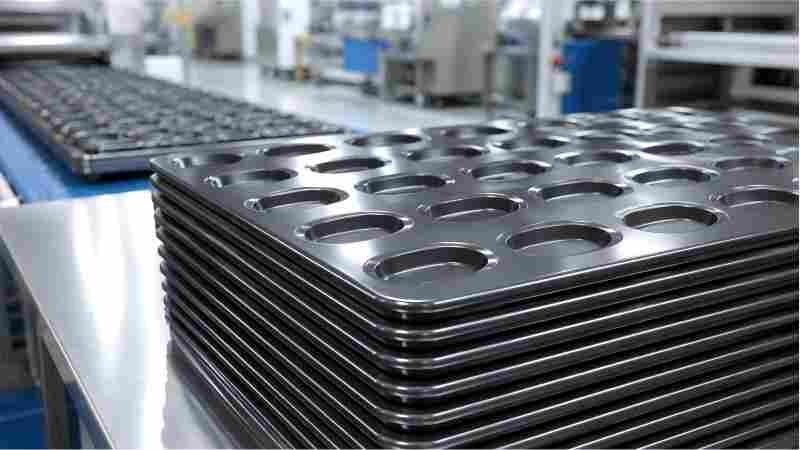
When I talk to plant managers, their biggest frustration is often equipment that can't withstand the daily grind. That's where the material choice becomes so important. Aluminized steel provides the perfect balance of properties needed for industrial-scale baking. It heats up quickly and evenly, which is critical for product consistency when you're producing thousands of loaves an hour.2 Unlike pure aluminum, it has the structural strength to resist warping under high heat and during constant movement by robotic arms.3 I've seen clients switch to aluminized steel and immediately notice a drop in rejected products and an increase in the lifespan of their pans.4
Material Comparison for Industrial Baking
| Feature | Aluminized Steel | Pure Aluminum | Stainless Steel |
|---|---|---|---|
| Heat Transfer | Excellent | Very Good | Fair |
| Durability | Excellent | Good | Excellent |
| Corrosion Resistance | Very Good | Good | Excellent |
| Warp Resistance | Excellent | Fair | Very Good |
| Weight | Moderate | Light | Heavy |
This combination of features makes aluminized steel a smart investment. It’s tough enough for automated systems and provides the performance needed for high-quality, consistent results.
How Do Custom Frames and Stacking Features Boost Efficiency?
Is the manual handling of baking pans creating bottlenecks on your automated line? This slows down production, increases labor costs, and leads to damaged equipment from improper stacking and movement.
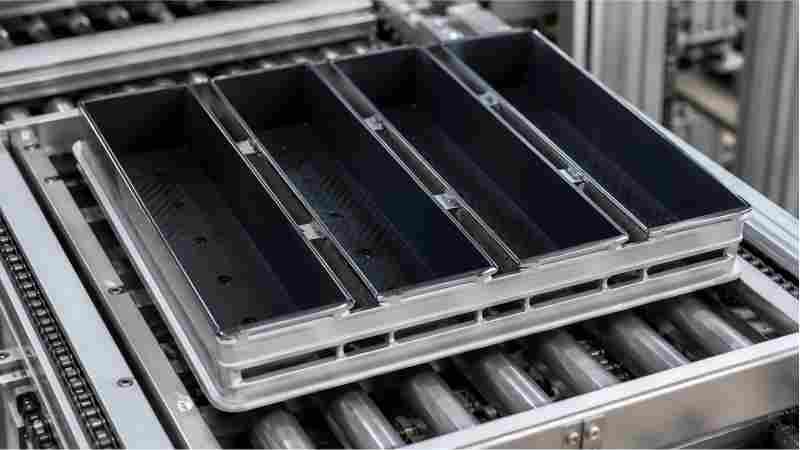
Custom frames allow pans to lock securely onto conveyor tracks in tunnel ovens, ensuring stable and continuous baking. Meanwhile, smart stacking designs ensure pans align perfectly for automated loading, transport, and washing. This integration with machinery maximizes workflow speed and minimizes manual intervention.
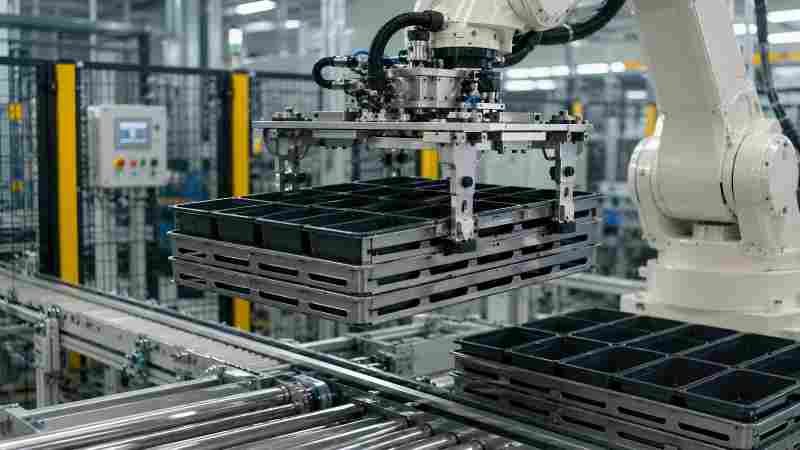
I remember working with a large bakery where the production line would stop multiple times a day. The problem? Their standard pans would shift slightly on the conveyor inside their new tunnel oven, tripping a sensor. It was a simple but costly issue. We designed a new pan with a reinforced outer frame that slotted perfectly into their oven's track system. The result was immediate. Their downtime from pan-related errors dropped to nearly zero. This is a perfect example of how a small design change can have a huge impact on efficiency.
The Role of Custom Frames in Tunnel Ovens
In a traditional setup, bakers manually load and unload ovens. But in an automated facility, tunnel ovens operate continuously. Pans must travel smoothly and securely on a track. A custom frame ensures the pan is perfectly seated on the conveyor, preventing any movement that could disrupt the baking process or damage the machinery.5 This is especially critical for products like our multi-loaf toast pans, which are heavy and need absolute stability throughout the entire baking, cooling, and depanning cycle.6
Smart Stacking for a Seamless Workflow
After baking, pans need to be collected, cooled, washed, and stored. Without proper design, this becomes a logistical nightmare. Pans that are designed to stack neatly can be handled by robotic arms, moved efficiently on conveyors, and loaded into industrial washers without jamming.7 This reduces labor, prevents damage to the pans' non-stick coatings, and keeps the entire production floor organized and flowing smoothly.
What Makes Data Matrix Codes Essential for Traceability?
A quality issue appears in a finished batch, but you have no idea what caused it. You are forced to discard thousands of products, wasting time, ingredients, and money because you can't pinpoint the source of the problem.
A Data Matrix code is a small, durable, laser-etched barcode on each pan. It holds a unique ID, allowing you to track a pan's entire lifecycle, including usage cycles, cleaning history, and performance.8 This helps you quickly isolate problems down to a single pan.
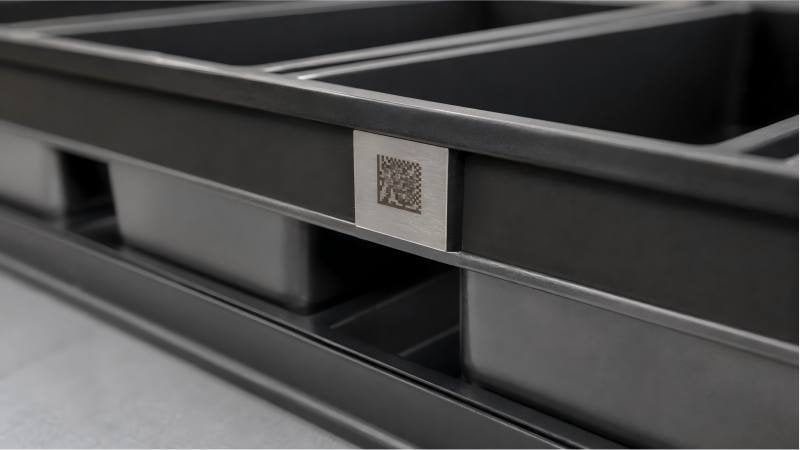
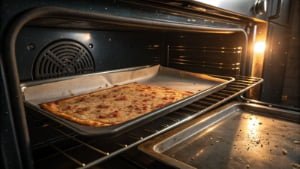
Traceability is no longer a luxury; it's a necessity for modern food production. I once consulted for a client who was experiencing random batches of undercooked pizza bases. The issue was sporadic and impossible to predict. We implemented pans with Data Matrix codes. By scanning the code on the pans used for each batch, they discovered the problem was linked to a specific set of pans whose non-stick coating was nearing the end of its life, affecting heat transfer. Instead of guessing, they could pull those specific pans from circulation for recoating. This level of precision saves enormous amounts of waste and ensures consistent quality. These codes are etched with a laser, so they won't fade or wash away, even after thousands of baking and washing cycles.9
Key Benefits of Pan-Level Traceability
| Benefit | Description |
|---|---|
| Precise Problem-Solving | If a product defect occurs, you can scan the batch code and trace it back to the exact pans used, isolating the issue instantly. |
| Proactive Maintenance | Track the number of bake cycles for each pan. The system can automatically flag a pan for recoating or replacement before it fails. |
| Process Optimization | Correlate pan data with baking outcomes. You can identify which pans, coatings, or cleaning cycles produce the best results and standardize them. |
| Inventory Management | Always know how many pans you have, where they are in the production cycle, and when you need to order more. |
This technology transforms your baking pans from simple metal trays into smart assets that provide valuable data for your entire operation.
Conclusion
For automated lines, choose aluminized steel pans with custom frames, stacking features, and Data Matrix codes. This approach will maximize your efficiency, durability, and control over the production process.
"The Role of Al-10%Si Coating in the Manufacture and Use of ...", https://pmc.ncbi.nlm.nih.gov/articles/PMC9228244/. Technical materials references and manufacturer-neutral metallurgy summaries describe aluminized steel as a steel substrate coated with aluminum or an aluminum-silicon alloy, combining benefits of steel (mechanical strength) and aluminum (thermal conductivity and corrosion resistance); such sources support the claim about combined properties while noting performance depends on coating type and thickness. Evidence role: definition; source type: education. Supports: Aluminized steel combines the strength of steel with the heat conductivity and corrosion resistance of aluminum.. Scope note: General materials summaries describe typical properties but performance varies with specific alloy, coating process, and operating conditions. ↩
"Analysis of modes of heat transfer in baking Indian rice pan cake ...", https://pmc.ncbi.nlm.nih.gov/articles/PMC4519496/. Food engineering and heat-transfer literature explains that pan thermal conductivity and thermal mass affect bake uniformity and throughput; these sources support the link between pan heat-transfer properties and product consistency at high-volume baking, while noting that oven design and process controls also strongly influence outcomes. Evidence role: mechanism; source type: paper. Supports: Heat-transfer properties of pans affect bake uniformity and thus product consistency in high-throughput baking.. Scope note: Sources support a general mechanism (heat transfer affects bake uniformity) but do not provide a quantified guarantee for all production scales since oven and process variables also matter. ↩
"Thermal Stability of Aluminum Alloys - PMC - NIH", https://pmc.ncbi.nlm.nih.gov/articles/PMC7435424/. Materials-engineering references and industry guidance compare mechanical strength and high-temperature creep/warping behavior of thin aluminum sheet versus steel substrates, supporting the statement that aluminized steel typically offers greater structural rigidity and resistance to deformation under mechanical/thermal stress than pure aluminum sheets of similar thickness; applicability depends on thickness, temper, and specific alloy. Evidence role: mechanism; source type: education. Supports: Aluminized steel generally has greater structural strength and resistance to warping under combined heat and mechanical handling than thin pure-aluminum pan constructions.. Scope note: Comparisons depend on sheet thickness and alloy; aluminized steel is not universally superior to all aluminum constructions under every condition. ↩
"Aluminum vs Stainless Steel Baking Trays: Which Wins for Your ...", https://kkbake.com/aluminum-vs-stainless-steel-baking-trays-which-wins-for-your-bakery/. Industry case reports and technical bulletins from neutral baking-industry or manufacturing publications document instances where changing pan materials reduced defect rates and extended service life; such sources can support observed benefits as case examples but do not prove universal results. Evidence role: case_reference; source type: other. Supports: Industry case reports showing that switching pan materials (for example, to aluminized steel) can reduce product rejects and increase pan service life in specific operations.. Scope note: Case reports illustrate possible outcomes in specific operations but cannot be generalized to all bakeries without controlled comparative studies. ↩
"Tunnel Ovens for Commercial Bakery - The Henry Group", https://www.thehenrygroup.com/bakery-tunnel-ovens.html. Conveyor and bakery-equipment engineering guides describe how pan seating, track engagement, and mechanical fit affect stability and sensor operation in tunnel-oven conveyors; these sources support the assertion that proper pan fit reduces movement that can trigger jams or sensor faults. Evidence role: mechanism; source type: research. Supports: Proper pan seating and frame design reduce pan movement on tunnel-oven conveyors and can prevent disruptions or machinery damage.. Scope note: Guidance supports the mechanism in general conveyor designs; specific conveyor/pan interactions depend on the equipment model and installation tolerances. ↩
"What weight for a standard loaf pan? - Facebook", https://www.facebook.com/groups/1006060197306320/posts/1601339627778371/. Baking-equipment specification sheets and industry sources indicate that multi-loaf or high-capacity pans can be significantly heavier than single-loaf pans and that heavier loads require more robust conveyor engagement and handling provisions; such sources support the assertion about the need for stability while noting weight varies by design. Evidence role: general_support; source type: institution. Supports: Multi-loaf toast pans are heavier than single-loaf pans and thus require more robust handling and stability measures on automated lines.. Scope note: Product weight and handling requirements vary with pan design and material; sources can show typical weights and handling recommendations but not a universal rule for every 'multi-loaf' pan. ↩
"Robotic Stacking Systems | Pick and Place Robots - Mesh Automation", https://meshautomationinc.com/material-handling/robotic-stacking-systems/. Robotics-in-manufacturing and automated material-handling literature discuss how predictable geometry (stackable designs and consistent gripping surfaces) facilitates reliable robotic gripping, conveyor transport, and washer loading; these sources support the claim that stackable pan design improves automation reliability. Evidence role: mechanism; source type: research. Supports: Stackable, consistent pan geometry enables more reliable robotic handling, conveyor transport, and automated washer loading, reducing jams.. Scope note: Support is general: specific robotic gripper designs and conveyor/washer interfaces determine real-world outcomes. ↩
"FSMA Final Rule on Requirements for Additional Traceability Records", https://www.fda.gov/food/food-safety-modernization-act-fsma/fsma-final-rule-requirements-additional-traceability-records-certain-foods. Standards documentation and industrial-traceability sources describe Data Matrix as a 2D barcode format capable of encoding unique identifiers compactly; combined with asset-management systems, Data Matrix marks can be used to record lifecycle events (usage cycles, cleaning) for individual assets, although implementation requires system integration. Evidence role: definition; source type: other. Supports: Data Matrix codes can store unique identifiers and, when scanned into an asset-management system, enable tracking of an item's lifecycle events.. Scope note: Data Matrix capability to encode IDs is well documented, but actual lifecycle tracking requires a supporting data-management system and procedures. ↩
"Laser Engraving for Metal: UV Laser Applications | KEYENCE America", https://www.keyence.com/products/marker/laser-marker/materials/metal-marking.jsp. Technical publications on industrial laser marking report that properly configured laser etching on metals produces durable marks resistant to abrasion, high temperatures, and many wash cycles; however, mark longevity depends on marking method, substrate, surface preparation, and sanitization chemicals used. Evidence role: general_support; source type: research. Supports: Industrial laser etching on metal substrates produces durable marks that resist abrasion, heat, and many cleaning cycles, supporting assertions about mark permanence on pans.. Scope note: Durability claims are conditional: laser marks are robust in many settings but may degrade under extreme abrasive or chemical conditions; specifics depend on materials and process. ↩