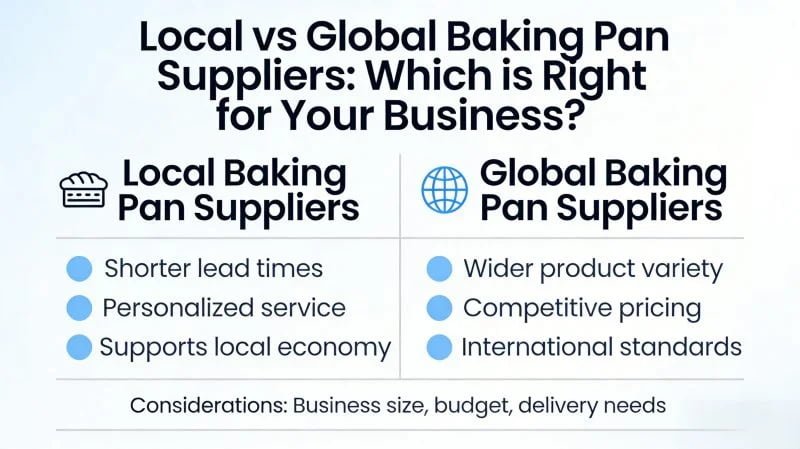
Are you struggling to source the right baking pans1? Choosing between a local supplier's speed and a global supplier's price can be a tough decision for any business owner.
For most bakeries and food plants, sourcing globally from a manufacturing hub2 like China is the most cost-effective choice. Even after adding shipping costs3, the total price for high-quality, durable baking pans1 is often significantly lower than buying from a local supplier in Europe or the Americas.
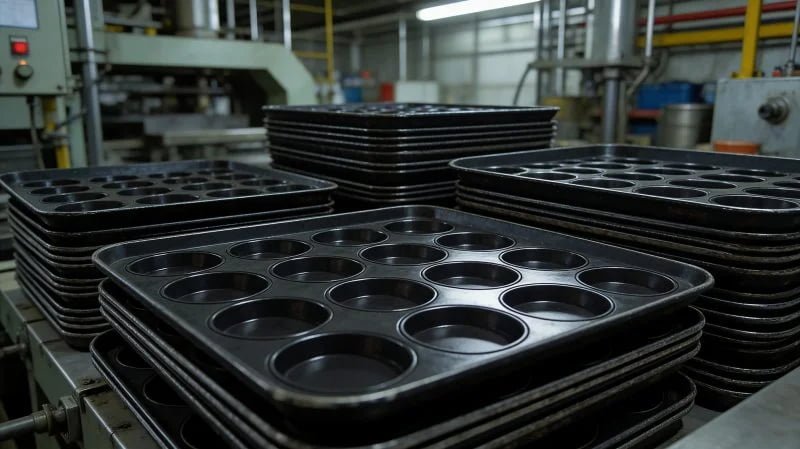
The answer might seem simple, but I know you have more questions about shipping, quality, and timing. I've been in this business for decades, and I've helped customers all over the world navigate this exact decision. Let's break down the real factors you need to consider. It's important to look beyond the sticker price and understand the total value. Let's dive into the details that matter most to your bottom line.
Is Sourcing Globally Really Cheaper When You Add Shipping?
You see a low price from an overseas supplier, but you worry shipping costs3 will erase all the savings. This fear of hidden fees can make you stick with expensive local options.
Yes, sourcing globally is almost always cheaper for bulk orders4, even with shipping included. For any order of more than a few dozen pans, the total cost of buying from China and shipping to your facility is lower than buying the same quality pans locally.

I get this question all the time, especially from new customers in Europe or the United States. They see our factory prices and think it's too good to be true. They assume shipping a large, heavy order of steel or aluminum pans across the ocean will be incredibly expensive. But the math tells a different story.
The key is understanding how we ship. Almost all of our international orders travel by sea freight5. Bakeware is dense and stacks efficiently inside a shipping container. Because we ship in such large volumes, the cost per individual pan becomes very small. A single container can hold thousands of pans, spreading the shipping cost thinly across the entire order.
Let's look at a simple, practical comparison.
Total Cost Breakdown: Local vs. Global
| Factor | Local Supplier (e.g., Germany) | Global Supplier (KKbake, China) |
|---|---|---|
| Pan Price (Per Unit) | $30.00 | $12.00 |
| Order Size | 500 pans | 500 pans |
| Total Product Cost | $15,000 | $6,000 |
| Shipping & Logistics | $200 (Local Trucking) | $2,000 (Sea Freight + Port Fees) |
| Total Final Cost | $15,200 | $8,000 |
| Final Cost Per Pan | $30.40 | $16.00 |
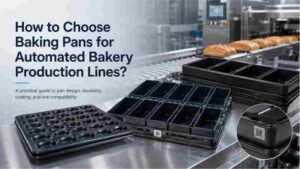
As you can see, even with a significant shipping cost, the total price per pan from a global supplier is nearly half. The initial manufacturing cost advantage in China is just too large to ignore. For a purchasing manager like Klaus in Germany, this saving means he can stay on budget without sacrificing the quality his automated lines6 demand. The choice becomes obvious.
Won't International Shipping Take Too Long for My Project?
Your new bakery or production line has a strict deadline. You can't afford to have your entire operation waiting for a shipment of pans that is stuck on a boat for months.
International shipping times, usually about a month by sea, are rarely a problem for commercial projects. This delivery window fits perfectly into the overall timeline needed to prepare your facility, install other equipment, and train your staff before launch.
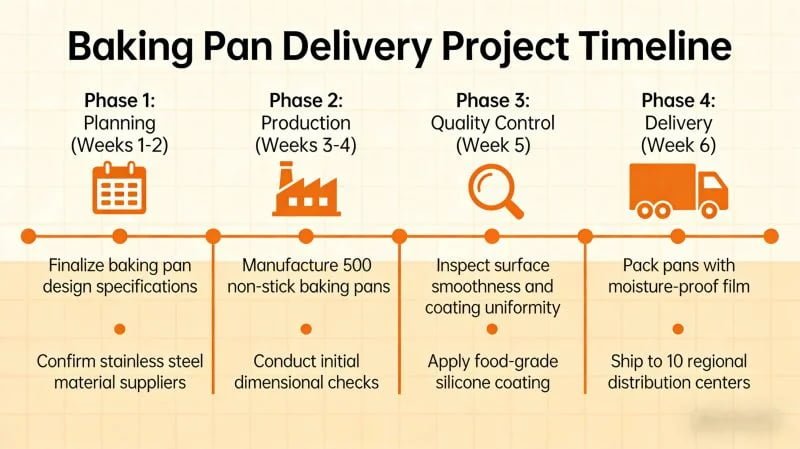
I understand the concern completely. Time is money. No one wants an empty kitchen or an idle production line. But in my experience, the shipping time for an international order is not "dead time." It is productive waiting time that runs parallel to your own preparations. Think about what it takes to launch a new product or open a new location. You have to finalize recipes, order and install ovens, set up workstations, and hire and train employees. This process doesn't happen overnight. It often takes several weeks, if not months.
Your baking pan order fits right into that schedule. We had a client, a national chain in Australia, who needed pans for 50 new coffee shop locations. While we were manufacturing their custom-sized non-stick pans, their team was busy with construction and staff onboarding. The pans were made, put on a ship, and arrived in Sydney right as they were ready for the final setup. The timing worked perfectly.
How Shipping Fits Into Your Project Timeline
| Week | Our Action (KKbake in China) | Your Action (At Your Facility) |
|---|---|---|
| 1-2 | Finalize design, prepare materials. | Finalize facility layout, order large ovens. |
| 3-6 | Manufacture pans, perform quality control7. | Begin site renovations, recruit new staff. |
| 7-11 | Pans are in transit via sea freight5. | Complete major installations, begin staff training. |
| 12 | Pans arrive, clear customs, deliver to you. | Finalize setup, prepare for grand opening. |
This timeline shows that the one-month shipping window is not a delay. It's a built-in part of a well-managed project plan. We ensure your pans arrive exactly when you need them, just as the final pieces of your puzzle are falling into place.
Can I Trust the Quality and Get Custom Sizes from an Overseas Supplier?
You need pans with exact dimensions for your automated line or a unique coating for a special product. You worry that ordering from a supplier thousands of miles away is a huge risk.
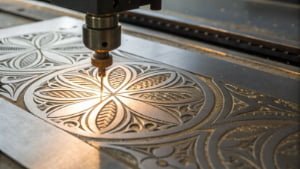
Absolutely. A professional global manufacturer in China offers deep customization and strict quality control7. We use advanced CNC machinery8 for precision and hold certifications like ISO90019 and CQC to guarantee our quality meets the highest industrial standards.
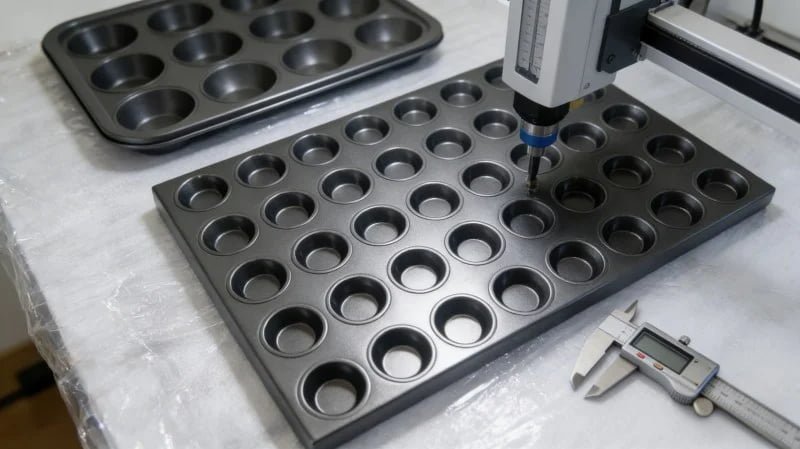
This is perhaps the most important question. Price and timing mean nothing if the product is wrong. The "Made in China" label has changed a lot over the last few decades. For industries like ours, it now stands for advanced technology and massive scale. At our facility, we have a dedicated research and development team of over 40 people. We use laser cutting machines and CNC benders that ensure every pan in a batch of thousands has a tolerance of less than one millimeter. This is the kind of precision required by large industrial bakeries.
We work with clients who have very specific needs. For a luxury hotel chef in Dubai, we created extra-large, extra-thick roasting pans to cook whole lambs. For a food science researcher in Canada, we produced small batches of 316 stainless steel pans with a polished surface to ensure her experiments were not contaminated. It's not just about making thousands of the same pan; it's about having the technical ability to solve each customer's unique problem.
Our Customization and Quality Assurance Process
- Consultation: First, we talk with you to understand exactly what you need. What size? What material? What will you be baking, and at what temperature?
- Design & Prototyping: Our engineers create detailed drawings. Once you approve the design, we can make a physical sample for you to test in your own facility.
- Testing & Approval: You get to see, feel, and use the pan. You can check that it fits your racks, works with your automation, and produces the perfect bake.
- Mass Production: Only after you give final approval do we begin full production. Every single pan is made to the exact standard of the sample you approved.
This process removes the risk and uncertainty. You are in control at every step, ensuring the final product you receive is exactly what your business needs to succeed.
Conclusion
Global sourcing from China offers a winning mix of lower costs, manageable lead times, and high-quality custom products. For most smart businesses, the choice is clear and the benefits are huge.
Explore this link to discover top-rated baking pans that can enhance your baking efficiency and quality. ↩
Discover why China is a leading manufacturing hub and how it benefits your baking business. ↩
Understanding shipping costs is crucial; this link breaks down how they impact your overall expenses. ↩
This resource highlights the advantages of bulk ordering, including cost savings and efficiency. ↩
This link explains sea freight logistics, crucial for understanding international shipping for baking supplies. ↩
Find out which baking pans are best suited for automated lines to enhance your production efficiency. ↩
Explore this resource to understand essential quality control practices in baking pan manufacturing. ↩
Discover how CNC machinery enhances precision and quality in baking pan production. ↩
Learn about ISO9001 certification and its importance in ensuring high-quality baking pans. ↩