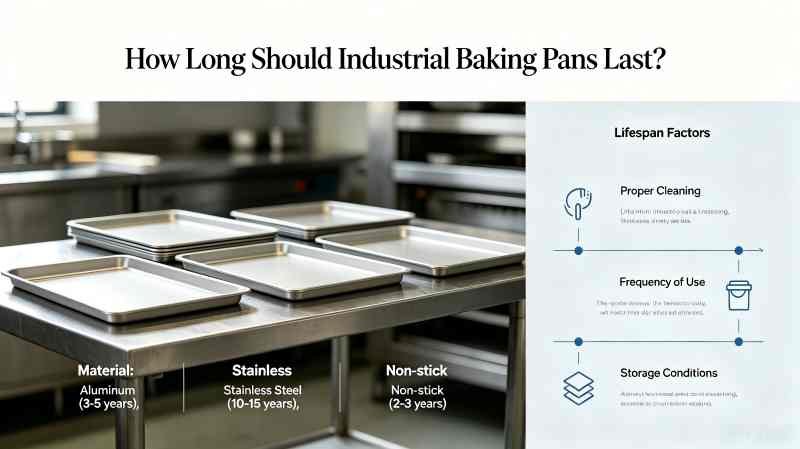
Constantly replacing baking pans is expensive and disrupts your workflow. This hidden cost eats into profits. Let's explore the true lifespan of industrial pans to help you invest wisely.
In our experience, most industrial baking pans last for about two years.1 The main reason is the non-stick coating wears down.2 Even pans without a coating often deform or corrode after two years of heavy use in a commercial setting3, affecting baking results.
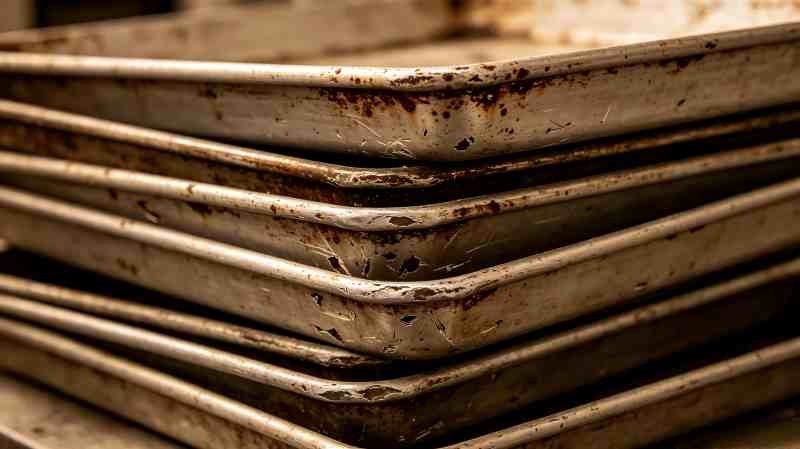
I've seen it countless times in our factory. A manager thinks they're saving money on cheaper pans, only to replace them twice as often. The two-year mark seems to be a hard limit for most standard equipment.4 But why is that? And more importantly, what can be done about it? Let's break down the reasons why pans fail and explore the solutions that have worked for us and our clients, like Klaus in Germany, who demand extreme durability. The answers might change how you budget for equipment forever.
Why Do Most Industrial Pans Fail After Two Years?
You bought new pans, but after a while, products start sticking and baking unevenly. It's frustrating. Let's pinpoint the exact reasons why this happens around the two-year mark.
The primary reason is coating failure. Non-stick layers wear away from repeated use, washing, and stacking. The second reason is structural fatigue. The metal itself can warp from heat stress or corrode from moisture and cleaning agents, making the pan unusable.
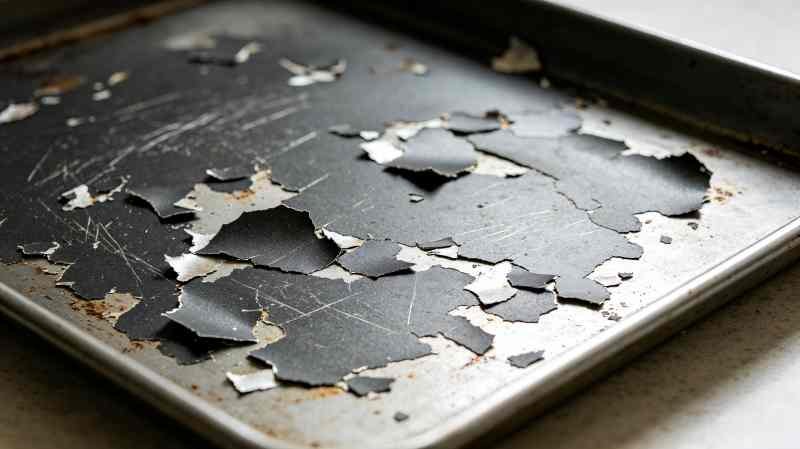
Let’s look closer at these two culprits. They seem simple, but the details matter. When a pan fails, it's almost always due to one of these issues, or a combination of both.5
Coating Degradation
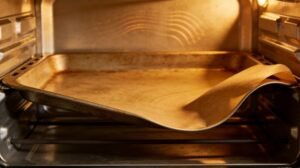
The non-stick coating is a workhorse, but it has a finite life. Every time a pan is heated, cooled, scraped, or washed, tiny bits of the coating are stressed. Over thousands of cycles, this leads to micro-cracks and eventually peeling. Once the coating is gone, food starts to stick, which ruins products and slows down your entire production line. This is the most common reason we see for pan replacement.
Structural Failure
The pan's metal body is also under constant attack. Thermal shock, the rapid change from a hot oven to cool air, causes the metal to expand and contract. This can lead to warping over time, so the pan no longer sits flat on racks or conveyors.6 Corrosion is another enemy, especially for standard steel pans which will rust when exposed to moisture and cleaning chemicals.7
Here is a simple breakdown:
| Failure Type | Primary Cause | Visible Sign |
|---|---|---|
| Coating Wear | Abrasion, Washing, Heat Cycles | Flaking, Sticking Food |
| Warping | Thermal Shock, Physical Impact | Pan doesn't sit flat |
| Corrosion | Moisture, Cleaning Chemicals | Rust spots, Pitting |
Understanding these points is crucial. It's not just about age; it's about the number of use cycles and the type of stress the pan endures.
What Makes Some Baking Pans Last Longer Than Others?
Ever wonder why some pans last so much longer? It feels like a secret. The difference isn't luck; it's in the materials and design that extend a pan's working life.
The key is using better materials and surface preparation. Aluminized steel offers superior corrosion resistance and durability compared to standard steel.8 Sandblasting the surface before applying a non-stick coating creates a stronger mechanical bond, making the coating last significantly longer.9
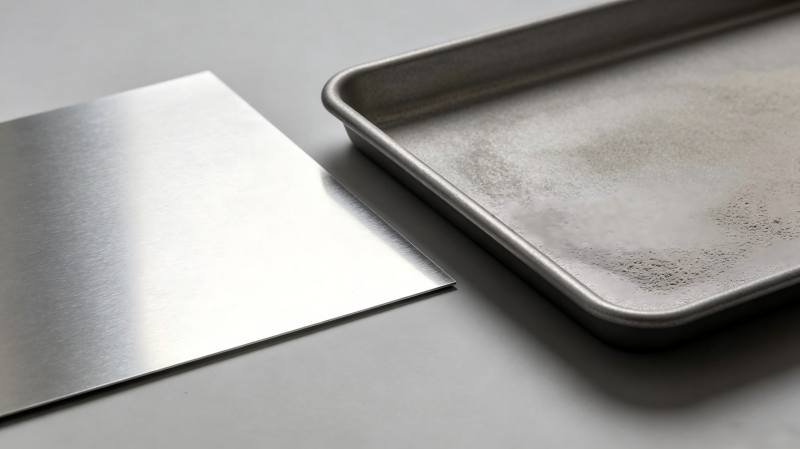
At our company, we've focused on this problem for years. The solution we found comes down to two key upgrades that dramatically increase lifespan and give our customers a better return on their investment.
The Power of Aluminized Steel
Standard steel pans rust. Aluminum pans are lightweight but can warp easily under industrial stress. Aluminized steel gives you the best of both worlds. It's a steel core coated with an aluminum-silicon alloy. The steel provides strength and prevents warping, while the aluminum coating provides excellent corrosion resistance and heat transfer.10 This combination is a game-changer for durability. A pan made from this material simply won't rust out like a standard steel pan.
Why Sandblasting is Crucial
A non-stick coating needs something to hold onto. Applying it to a perfectly smooth surface is like painting on glass—it peels off easily. Sandblasting creates a rough, textured surface at a microscopic level. This gives the coating thousands of tiny anchor points, creating a much stronger mechanical bond. This is why our coatings resist peeling long after others have failed.
| Feature | Standard Pan | Our Enhanced Pan |
|---|---|---|
| Base Material | Carbon Steel | Aluminized Steel |
| Coating Prep | Basic Cleaning | Sandblasting |
| Expected Life | ~2 years | 3-5+ years |
Is Re-coating a Cost-Effective Alternative to Replacing Pans?
Buying all new pans is a huge cost. You've heard about re-coating to save money, but does it really work? Let’s look at when this is a smart financial move.
Re-coating can be very cost-effective, but only if the pan's structure is still sound. If you use high-quality aluminized steel pans, the body can easily outlast the coating.11 In this case, stripping and re-coating is much cheaper than buying a new pan.
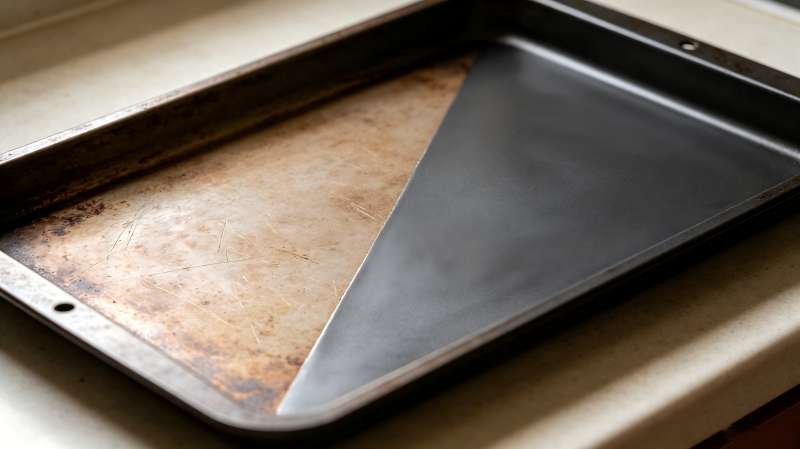
We have clients, like Klaus who runs a massive industrial bakery in Germany, who ask this exact question. The answer always depends on the quality of the original pan. You can't put a new engine in a car with a rusted-out frame. The same logic applies here.
When to Re-coat
If your pan is made from a durable material like heavy-gauge aluminized steel and is not warped or severely damaged, it's a perfect candidate for re-coating. The process involves chemically stripping the old coating, sandblasting the surface clean, and applying a new, high-performance non-stick layer. The cost is typically 30-50% of a new pan, making it a great value12 and extending the life of your initial investment.
When to Replace
However, if your pan is made of cheaper steel, is already warped, or has started to rust through, re-coating is a waste of money. The new coating won't fix the underlying structural problems, and you'll be facing the same issues again very soon.
Here's a quick decision guide:
| Pan Condition | Material | Recommendation | Reason |
|---|---|---|---|
| Worn Coating, Good Body | Aluminized Steel | Re-coat | Cost-effective, pan body is still valuable |
| Warped or Rusted | Any | Replace | Re-coating won't fix structural flaws |
| Worn Coating, Good Body | Standard Steel | Consider Replacement | Pan may corrode soon anyway |
By investing in better pans upfront, you give yourself the option to save money with re-coating down the line. It's about thinking long-term.
Conclusion
A typical pan lasts two years. But investing in quality materials like aluminized steel extends its life and makes re-coating a smart, cost-saving option for the future.
"How Long Should Industrial Baking Pans Last in Daily Production?", https://kkbake.com/how-long-should-industrial-baking-pans-last-in-daily-production/. Industry guidance and equipment-lifecycle studies that document typical service lives for commercial bakeware or similar food‑service metal equipment can support a statement about common replacement intervals; such sources typically show wide variation by usage intensity and material and do not establish a universal two‑year rule. Evidence role: statistic; source type: education. Supports: In our experience, most industrial baking pans last for about two years.. Scope note: Available sources report ranges and depend heavily on use cycles, so they can support typical intervals but not a single hard rule for all operations. ↩
"Influence of heating temperature and time on mechanical ... - PMC", https://pmc.ncbi.nlm.nih.gov/articles/PMC11324993/. Materials and coatings literature describing degradation mechanisms of PTFE and other non‑stick coatings (abrasion, thermal cycling, chemical attack) can substantiate that non‑stick layers wear with repeated use and cleaning. Evidence role: mechanism; source type: paper. Supports: The main reason is the non-stick coating wears down.. Scope note: Such sources explain the mechanisms of coating degradation but typically quantify lifespan only in general terms that depend on operating conditions and coating formulation. ↩
"Carbon Steel Pan Rust - de Buyer", https://www.debuyer-usa.com/blogs/how-to/carbon-steel-pan-rust?srsltid=AfmBOoqm8QbCVGflUqRpvUkFG_owjPP141AyXFLQ7jy3RM4vy0o5Ptlf. Corrosion engineering and food‑service equipment guidance can show that uncoated carbon steel is susceptible to rust and that repeated high‑temperature cycling can cause deformation; such sources can support that heavy commercial use accelerates these failures though exact timing varies. Evidence role: general_support; source type: research. Supports: Even pans without a coating often deform or corrode after two years of heavy use in a commercial setting.. Scope note: Sources support susceptibility to corrosion and deformation under heavy use but do not guarantee a uniform two‑year timeframe for all uncoated pans. ↩
"[DOC] Equipment Preventative Maintenance Manual", https://www.twc.texas.gov/sites/default/files/vr/docs/equipment-preventive-maintenance-manual-twc.docx. Maintenance schedules or life‑cycle analyses from food‑service equipment guides can indicate typical replacement intervals for standard (lower‑grade) bakeware, supporting the notion of relatively short service lives in high‑use contexts while noting large variability. Evidence role: statistic; source type: education. Supports: The two-year mark seems to be a hard limit for most standard equipment.. Scope note: Guidance may present typical ranges rather than a strict 'hard limit'; local operating conditions change outcomes. ↩
"Uncover mistakes via coating failure analysis (Journal Article)", https://www.osti.gov/biblio/118810. Failure‑mode analyses for cookware or food‑processing equipment that list common causes (coating loss, corrosion, deformation) can corroborate that these are among the primary failure modes for bakeware. Evidence role: expert_consensus; source type: paper. Supports: When a pan fails, it's almost always due to one of these issues, or a combination of both.. Scope note: Analyses typically list multiple causes and rank them by frequency in particular settings; 'almost always' may overstate universality. ↩
"Controlling heat to prevent stainless steel warping - Facebook", https://www.facebook.com/groups/485362748969702/posts/1117366619102642/. Materials science and heat‑treatment resources that describe thermal cycling/thermal shock and its effects on thin metal components support the mechanism by which repeated temperature swings can cause distortion and warping. Evidence role: mechanism; source type: education. Supports: Thermal shock causes metal to expand and contract and can lead to warping over time.. Scope note: The rate and extent of warping depend on alloy, thickness, cycle amplitude, and handling; sources explain mechanism but not a uniform timeline. ↩
"Cleaning and Sanitizing in Commercial Kitchens | Clatsop County, OR", https://www.clatsopcounty.gov/796/Cleaning-and-Sanitizing-in-Commercial-Ki. Corrosion engineering and food‑safety cleaning guidance document how moisture and common cleaning chemicals promote rust on carbon steel surfaces, supporting the claim that unprotected steel is vulnerable in washdown environments. Evidence role: mechanism; source type: government. Supports: Standard steel pans will rust when exposed to moisture and cleaning chemicals.. Scope note: Degree of corrosion depends on steel alloy, surface protection, and cleaning agents; sources support vulnerability but not identical outcomes across all 'standard steel' pans. ↩
"Aluminized steel - Wikipedia", https://en.wikipedia.org/wiki/Aluminized_steel. Materials references and encyclopedic entries on aluminized steel explain that an aluminium‑silicon coating improves oxidation and corrosion resistance relative to bare carbon steel and is commonly used where both strength and corrosion resistance are needed. Evidence role: general_support; source type: encyclopedia. Supports: Aluminized steel offers superior corrosion resistance and durability compared to standard steel.. Scope note: Performance depends on coating thickness, integrity, and operating environment; 'superior' is relative and contextual. ↩
"Performance and Durability of Non-Stick Coatings Applied to ... - PMC", https://pmc.ncbi.nlm.nih.gov/articles/PMC10489068/. Surface‑engineering literature documents that abrasive blasting increases surface roughness and mechanical interlocking, improving adhesion of polymeric coatings; such studies support the general claim that sandblasting can improve coating life though longevity gains depend on process control and coating chemistry. Evidence role: mechanism; source type: paper. Supports: Sandblasting before coating creates a stronger mechanical bond and can improve coating longevity.. Scope note: Improved adhesion does not automatically translate to a specific lifespan increase; results vary with blasting media, roughness, and coating type. ↩
"Aluminized steel - Wikipedia", https://en.wikipedia.org/wiki/Aluminized_steel. Technical descriptions of aluminized steel show that a steel substrate supplies structural strength while the aluminum (or aluminum‑silicon) coating confers corrosion resistance and has different thermal conductivity characteristics than steel, supporting the composite explanation. Evidence role: mechanism; source type: institution. Supports: Aluminized steel's steel core provides strength while the aluminum coating contributes corrosion resistance and heat transfer properties.. Scope note: Heat transfer and anti‑corrosion performance depend on coating thickness and contact with food/ovens; practical benefits vary by design. ↩
"Evaluation of Substrates of Al-Mg and Aluminized Steel Coated With ...", https://pmc.ncbi.nlm.nih.gov/articles/PMC6266171/. Material lifespan studies and recoating‑service literature indicate that when substrate metal (e.g., aluminized or heavy‑gauge steel) remains structurally sound, coatings can be stripped and reapplied, allowing the substrate to outlast multiple coating lifecycles; such sources support the general point but note substrate condition is decisive. Evidence role: general_support; source type: paper. Supports: If the pan's structure is sound, its metal body can outlast the non‑stick coating, making re‑coating feasible.. Scope note: This applies when the substrate is not warped, thinned, or corroded; statements are conditional on substrate integrity. ↩
"Industrial Pan Coating: Commercial Bakeware Coating - Crest Coating", https://www.crestcoating.com/services/bcs-bakeware-coating/. Trade publications or technical bulletins on recoating industrial cookware or industrial coating service summaries sometimes provide typical cost ranges for recoating versus replacement; such sources can support a 30–50% cost estimate in some markets but costs vary by region, pan size, and coating specification. Evidence role: statistic; source type: other. Supports: Re‑coating costs are often a fraction (often cited in trade sources) of replacement cost, e.g., roughly 30–50% in some cases.. Scope note: Price ranges are market‑dependent; any cited percentage should be framed as typical in specific contexts rather than universal. ↩