Confused by varying quotes for custom baking pans? This price disparity makes choosing a supplier difficult and risky. Let's break down what truly drives the cost.
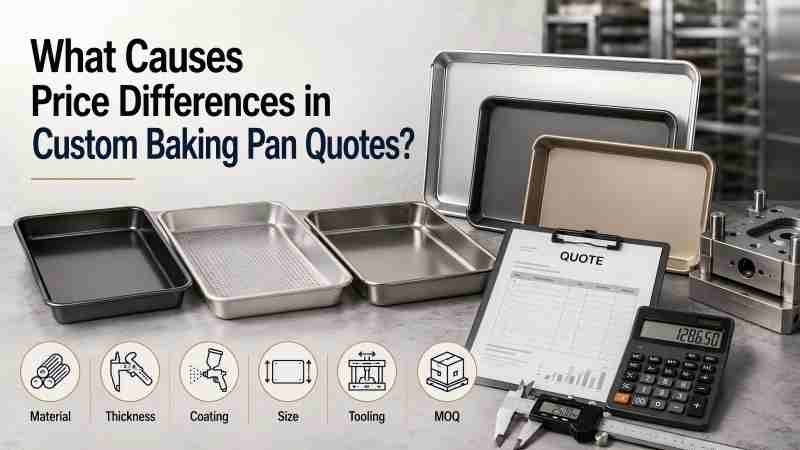
The primary factors determining the price of custom baking pans are the material choice and the overall thickness. For the same material, a thicker pan is more expensive. The type of metal, such as aluminum alloy versus aluminized steel, also creates a significant price difference.
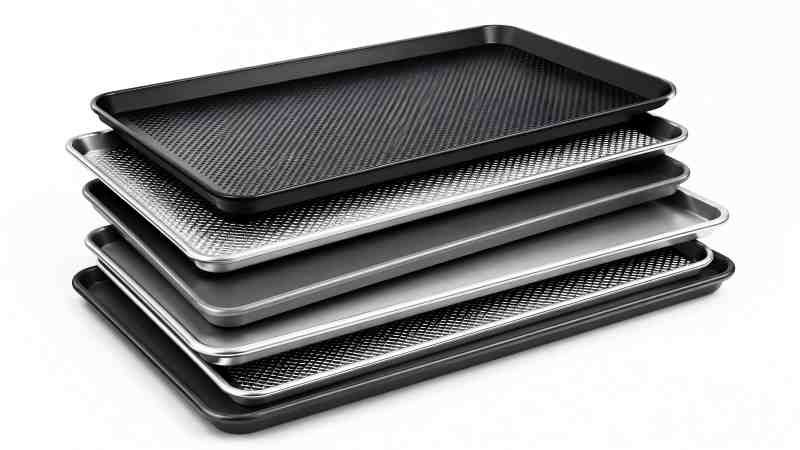
So, it's all about material and thickness. But this simple answer hides important details that affect your bakery's performance and budget. To choose wisely, you need to understand why these factors matter so much. Let's dig into the specifics.
Why Does Pan Thickness Impact the Price So Much?
You want durable pans, but a thicker gauge means a higher price. Is the extra cost justified, or are you overpaying for features you don't need?
Thicker pans use more raw material, which directly increases the cost. More importantly, they offer superior durability, better heat retention for even baking, and greater resistance to warping under high temperatures. This longevity often makes them a better long-term investment for busy commercial kitchens.
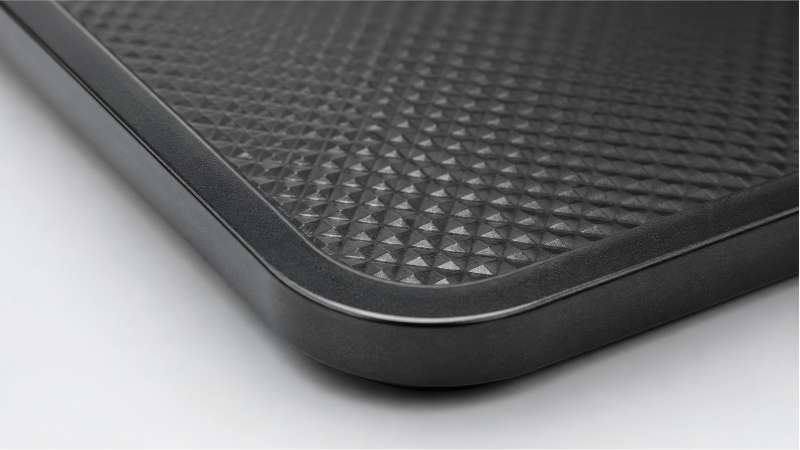
The most obvious reason a thicker pan costs more is that it uses more metal. But the price increase is about more than just the raw material. You are paying for better performance and a longer lifespan. I always tell my clients to think of it as an investment. A client of mine, a large industrial bakery plant manager in Germany, used to buy thinner pans to save costs. He found he was replacing them constantly due to damage. After switching to our thicker, heavy-duty pans, his replacement rate dropped dramatically, saving him money in the long run.
Heat Distribution
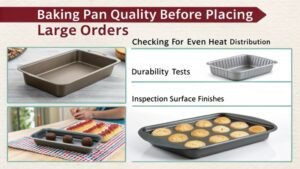
Thicker metal holds and distributes heat more evenly. This prevents hot spots and ensures your products bake uniformly, with consistent color and texture from edge to center.
Structural Integrity
In a busy commercial kitchen, pans are handled roughly. Thicker pans are far more resistant to dents, dings, and especially warping. A warped pan won't sit flat, leading to uneven baking and problems with automated production lines.
| Pan Thickness | Best Use Case | Key Benefit |
|---|---|---|
| 1.0 - 1.2mm | High-volume industrial lines | Extreme durability, warp-proof |
| 0.8 - 1.0mm | General commercial bakeries, chain stores | Good balance of durability & cost |
| 0.6 - 0.8mm | Lighter use, home baking, some food service | Lower initial cost, lightweight |
Which Baking Pan Material Gives the Best Return on Investment?
Choosing between materials like aluminum, aluminized steel, and stainless steel is confusing. A wrong choice can lead to short pan life and wasted money.
For most industrial bakeries, aluminized steel offers the best balance1. It's durable, has a long service life, and is more cost-effective than aluminum alloy. While stainless steel is strong, non-stick coatings adhere poorly to it, making it unsuitable for most baking applications.2
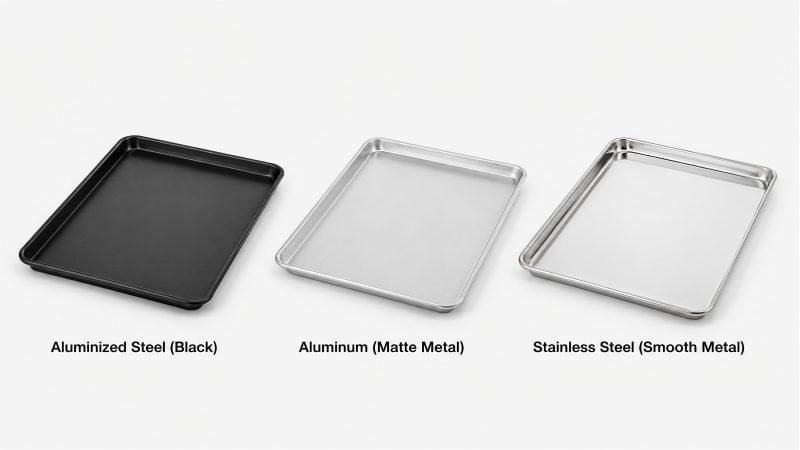
Based on our factory's decades of production experience, the choice of material is the most critical decision after thickness. It impacts everything from cost to how long the pan will last in your specific environment. We've made thousands of pans for every type of customer, from luxury hotel chefs to food science labs, and a clear winner has emerged for general commercial use.
The Workhorse: Aluminized Steel
This is the material we recommend most often. It's our top seller for a reason. Aluminized steel is a steel sheet coated with an aluminum-silicon alloy.3 This gives you the best of both worlds: the core strength and durability of steel, plus the heat conductivity and corrosion resistance of aluminum. It’s tough, reliable, and provides excellent baking results, making it perfect for almost any production setting.
The Alternatives
- Aluminum Alloy: This material is lighter and a fantastic heat conductor. However, it's generally more expensive than aluminized steel4. It is also softer, so to get the same durability, you need a much thicker and heavier pan, which further increases the cost.
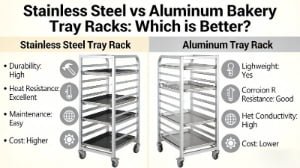
- Stainless Steel: Many people ask about stainless steel because it’s known for being durable and hygienic. However, it is a poor choice for coated industrial baking pans. Its surface is too smooth for non-stick coatings to grip properly, leading to peeling and a very short service life. It also tends to warp easily at typical baking temperatures.5
| Material | Price | Durability | Heat Conduction | Coating Adhesion | Best For... |
|---|---|---|---|---|---|
| Aluminized Steel | Mid | Excellent | Very Good | Excellent | Most industrial & commercial bakeries |
| Aluminum Alloy | High | Good | Excellent | Good | Specific applications requiring light weight |
| Stainless Steel | High | Excellent | Poor | Poor | Uncoated items like racks or mixing bowls |
What About Hidden Costs Like Molds and Shipping?
You've focused on material and thickness, but now you're worried about extra fees. Are mold and shipping charges going to inflate your final bill unexpectedly?
For large bulk orders, mold fees are often absorbed or spread out, making their impact on the per-unit price minimal.6 Shipping is usually a straightforward cost, but it can spike due to global events. However, material and thickness remain the primary price drivers by far7.
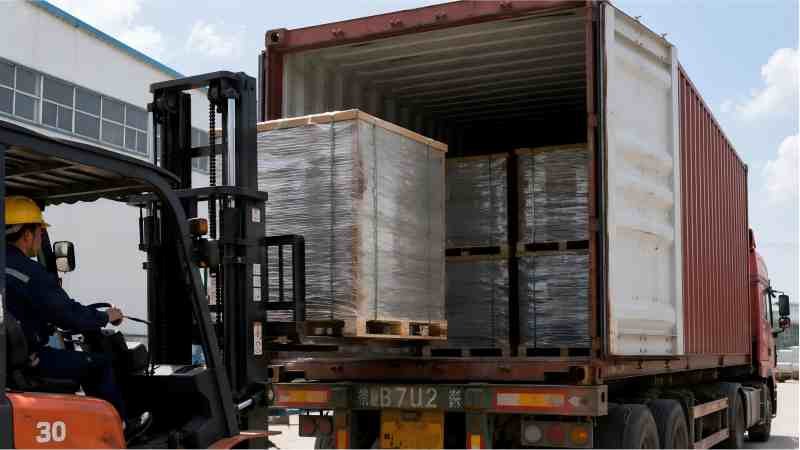
It's smart to ask about these other costs. No one likes surprises on their invoice. For completely custom pan designs, a new mold has to be created, and that has a cost. However, the way this impacts your price depends heavily on your order volume. If you order 10 special pans, the mold fee is a huge part of the total cost. But if you're ordering 5,000 pans for a national chain, like my client Sarah in Australia, the mold cost per pan becomes just pennies. At our factory, since we have our own mold-making team, we can control these costs effectively and often build them into a large order's pricing.
Shipping is another factor, but it's usually more predictable. It's a real cost that needs to be paid. However, it can be affected by things outside our control. For example, recent conflicts in the Middle East caused shipping prices to that region to soar temporarily8. But in most situations, these costs are secondary. The fundamental choices you make about material and thickness will always have the biggest impact on your quote.
| Cost Factor | Impact on Price (Large Order) | Notes |
|---|---|---|
| Material & Thickness | High | The core driver of cost and performance. |
| Mold Fee | Low | Amortized over the large number of units. |
| Shipping | Medium | A necessary cost, can fluctuate with world events. |
Conclusion
In conclusion, the price of custom baking pans is mainly set by material and thickness. Choosing the right combination ensures you get the best value and performance for your bakery.
"Aluminum vs Stainless Steel Baking Trays: Which Wins for ...", https://kkbake.com/aluminum-vs-stainless-steel-baking-trays-which-wins-for-your-bakery/. Comparative materials summaries (e.g., textbooks and neutral industry reviews) identify aluminized steel as combining a steel substrate's strength with an aluminized coating's corrosion resistance and improved surface properties, which many commercial bakers cite as a balanced choice for longevity and cost-effectiveness in high-volume baking. Evidence role: general_support; source type: research. Supports: Aluminized steel offers the best balance (durability, service life, cost-effectiveness) for most industrial bakeries. Scope note: ‘Best balance’ is a value judgment depending on the bakery's priorities (weight, conductivity, corrosion resistance); neutral sources describe trade-offs rather than a universal winner. ↩
"Adhesive-Free Adhesion between Plasma-Treated Glass-Cloth ...", https://pmc.ncbi.nlm.nih.gov/articles/PMC8838903/. Coating-technology sources and materials guides describe adhesion challenges for some non-stick (PTFE and similar) coatings on certain stainless-steel surface finishes, although adhesion can be improved with specific surface treatments; therefore stainless steel is less commonly used for coated bakeware without pre-treatment. Evidence role: mechanism; source type: research. Supports: Non-stick coatings adhere poorly to stainless steel, making stainless less suitable for coated baking pans. Scope note: Adhesion depends on surface finish and pre-treatment; modern coating processes can enable good adhesion on stainless in some cases, so blanket statements require nuance. ↩
"Aluminized steel - Wikipedia", https://en.wikipedia.org/wiki/Aluminized_steel. Reference works define aluminized steel as steel coated by an aluminum alloy (usually with silicon additions) applied by hot-dipping or other processes to impart heat and corrosion resistance; this is a standard materials definition. Evidence role: definition; source type: encyclopedia. Supports: Aluminized steel is a steel sheet coated with an aluminum-silicon alloy. Scope note: Process details (e.g., percent silicon, coating thickness) vary by manufacturer and grade and are not specified here. ↩
"[PDF] Aluminium versus steel in low-volume production of structural ...", https://www.ntnu.edu/documents/139799/1279149990/30+TPD4505+-+Aluminium+versus+steel+in+low-volume+production+of+structural+applications+.pdf. Price comparisons from materials commodity listings and industry procurement guidance indicate that bulk aluminum alloys typically have higher per-kilogram costs than coated steel products on a like-for-like basis, though total part cost depends on required thickness and fabrication. Evidence role: statistic; source type: other. Supports: Aluminum alloy is generally more expensive than aluminized steel (per unit material cost). Scope note: Raw-material prices fluctuate over time and between regions; a per-unit price advantage can be offset if aluminum parts must be much thicker to achieve comparable durability. ↩
"A Study on Thermally Fatigued Phase Transformation and Bending ...", https://pmc.ncbi.nlm.nih.gov/articles/PMC12155832/. Metallurgical references note that all thin metal sheets can warp under thermal cycling; stainless steels have different thermal expansion and modulus characteristics from aluminized steel and aluminum, and under some conditions thin stainless sheets may deform, but warping propensity depends on thickness, alloy, and thermal gradient. Evidence role: mechanism; source type: paper. Supports: Stainless steel tends to warp easily at typical baking temperatures. Scope note: This does not prove stainless universally 'tends to warp easily'—warping risk is a function of gauge, alloy, and baking cycles rather than material alone. ↩
"How Much Does Injection Molding Cost? 2026 Pricing Guide", https://weilinplastic.com/how-much-does-injection-molding-cost/. Manufacturing and procurement guides explain that one-time tooling or mold costs are amortized across production volume, so per-unit impact decreases as order quantity rises; the principle applies broadly across metal forming and tooling industries. Evidence role: historical_context; source type: education. Supports: Mold/tooling fees are amortized over large orders and become a small per-unit cost for high-volume production. Scope note: How much a supplier ‘absorbs’ tooling costs varies by manufacturer and negotiation; amortization reduces per-unit cost but does not eliminate the upfront investment. ↩
"[PDF] Costs and Cost Effectiveness of Additive Manufacturing", https://nvlpubs.nist.gov/nistpubs/specialpublications/nist.sp.1176.pdf. Cost-modeling literature for metal components identifies raw-material type and required mass/thickness as dominant contributors to unit cost, with tooling and logistics often secondary for large production runs; this is consistent with engineering procurement analyses. Evidence role: statistic; source type: paper. Supports: Material choice and thickness are the dominant contributors to unit cost of metal bakeware, more so than secondary charges for large orders. Scope note: Relative cost shares vary by order size and manufacturing process; for very small runs tooling or customization can dominate per-unit cost. ↩
"Red Sea attacks increase shipping times and freight rates - EIA", https://www.eia.gov/todayinenergy/detail.php?id=61363. Trade and logistics analyses (e.g., UNCTAD, shipping industry reports) document that regional conflicts and security incidents can and have led to temporary spikes in freight rates and rerouting costs for affected sea lanes and destinations. Evidence role: historical_context; source type: institution. Supports: Conflicts in the Middle East have in the past temporarily increased shipping prices to affected regions. Scope note: Specific magnitude and timing of rate spikes depend on the particular incident and shipping route; the sentence should be tied to a named event for precise support. ↩