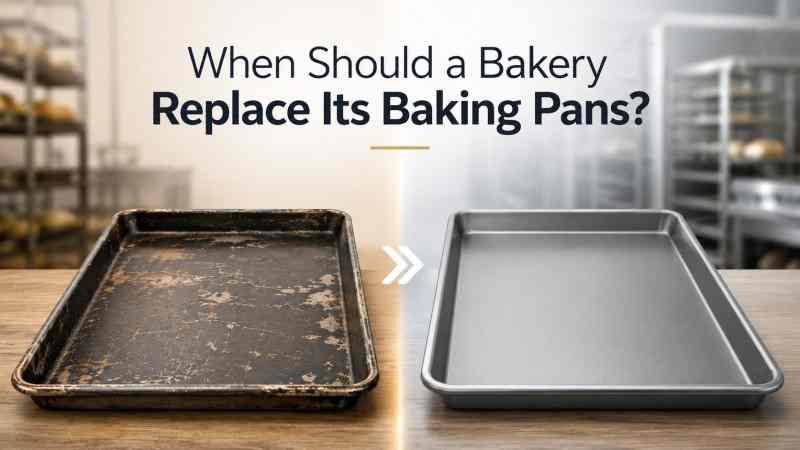
Your pans are worn, but replacement is a huge cost. Delaying could ruin products and slow production.1 Knowing the exact signs for replacement protects your bottom line and product quality.
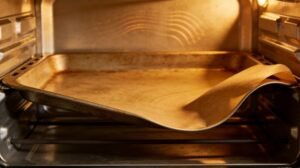
The time to replace your bakery's pans is when they negatively impact your production efficiency or product quality.2 Key signs include severe warping that causes uneven baking or jams automation3, and coating failure that makes depanning difficult and increases labor costs.4
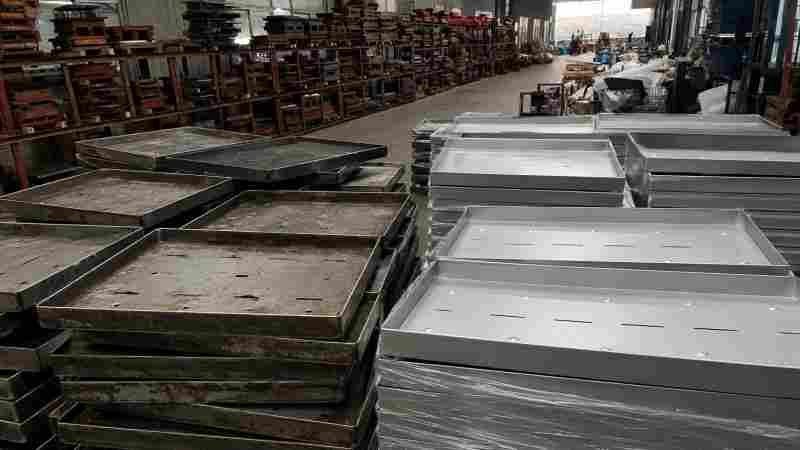
Deciding to invest in new bakeware is a major financial decision for any commercial bakery. It’s not as simple as throwing out a pan with a few scratches, which might be the standard for a home baker. In a professional setting, pans are workhorses, and we expect them to last. However, there comes a point where holding onto old pans costs you more than replacing them. The real question is how to identify that exact point. It's about understanding the specific signs that your pans are no longer assets, but liabilities to your operation. Let's break down the critical factors that tell you it's time for a change.
Is Pan Damage Hurting Your Production Line?
Warped pans and peeling coatings might seem like minor issues. But they can cause uneven baking, stuck products, and slow your entire line, quietly costing you money every day.
Yes, pan damage directly hurts production. Severe warping leads to inconsistent baking and can jam automated lines. When non-stick coatings fail, products stick, increasing manual labor for depanning and cleaning. This dramatically slows down workflow and increases product waste.
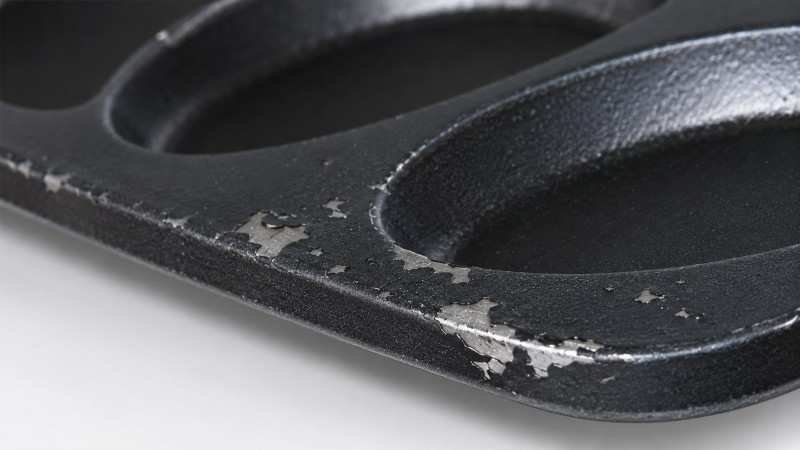
In my experience, the most obvious reasons for replacement are physical wear and tear. But it's crucial to connect that wear to a tangible business cost. It's not about aesthetics; it's about performance. Two main culprits consistently signal the end of a pan's useful life in a commercial setting: warping and coating failure.
The Impact of Warping
A warped pan is a serious problem. In a deck oven, it creates hot and cold spots, leading to products that are burnt on one side and undercooked on the other.5 This lack of uniformity is unacceptable for any brand. For an industrial operation using automated lines, the problem is even worse. I worked with a large-scale producer whose automated system required pans to fit with less than 1mm of tolerance.6 A slightly warped pan would jam the entire conveyor, causing a costly line stoppage.
The Cost of Coating Failure
When a non-stick coating fails, efficiency plummets. Instead of products sliding out cleanly, your team has to manually scrape and pry them loose. This not only damages the product but also adds significant labor time to each cycle. That extra minute spent on depanning, multiplied over hundreds or thousands of pans a day, adds up to massive labor waste.7
Here’s a simple breakdown of what to look for:
| Symptom | Impact on Production |
|---|---|
| Severe Warping | Uneven baking, inconsistent product quality, jams in automated lines. |
| Coating Failure | Products stick, increased depanning labor, higher product waste. |
| Corrosion/Rust | Risk of food contamination, poor heat transfer, shortened pan lifespan. |
Are Your Old Pans Compatible with New Equipment?
You're upgrading your bakery with new ovens or automation. But your existing pans might not work, turning that expensive upgrade into a frustrating bottleneck and a waste of money.
Often, they are not. New automated lines require pans with precise dimensions and features for robotic grippers.8 Modern ovens might demand pans made from different materials or with specific coatings for optimal heat transfer. Old pans can severely limit your new technology's potential.
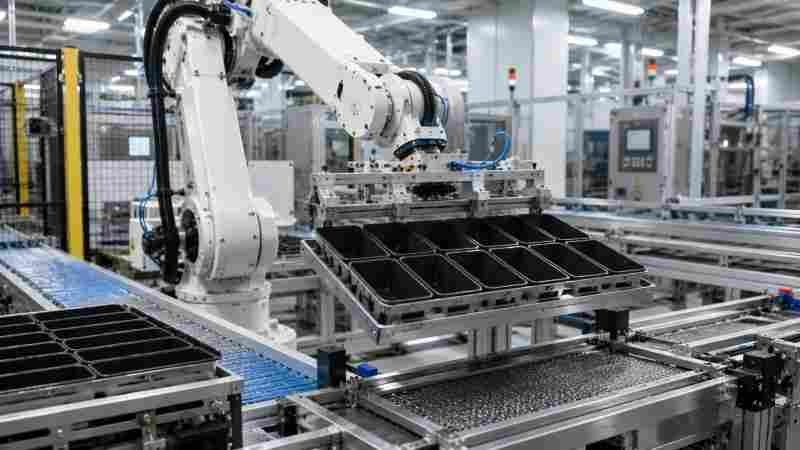
Sometimes, you need to replace pans that are still in decent physical condition. This happens when your bakery evolves. Investing in new technology like automation or high-efficiency ovens is a great step, but it's only effective if your entire production line, including your pans, is compatible. Using old pans with new equipment is like putting budget tires on a high-performance car; you simply won't get the results you paid for.
The Demands of Automation
I remember consulting for a plant manager in Germany who was installing a new robotic loading and unloading system. His old pans, while still functional, lacked the reinforced, perfectly uniform rims that the robotic grippers needed to securely hold them. The system couldn't function reliably. He had to invest in new, custom-sized pans designed for automation. The pans needed to be identical, with no variation, to ensure the entire line ran smoothly without errors.
Optimizing for New Ovens
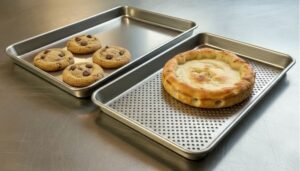
New oven technology also places new demands on bakeware. For example, if you switch to a modern impingement oven that uses high-velocity hot air, you may need perforated pans to allow for proper airflow and achieve a crisp crust.9 Your old solid-bottom pans would block this key feature. Similarly, many energy-efficient ovens perform best with dark-colored non-stick coatings that absorb heat more effectively.10 A chain bakery buyer I know specifically requests dark pans to reduce bake times and save on energy costs across her 50 locations. Your pans are not just holders; they are a critical part of the baking process itself.
When Does Keeping Old Pans Cost More Than Replacing Them?
New pans are a big expense, so it feels cheaper to keep using the old ones. But hidden costs from wasted ingredients, extra labor, and inconsistent quality are likely eating your profits.
The tipping point is when the cumulative cost of lost efficiency and product waste exceeds the cost of new pans.11 If your team spends extra time depanning or cleaning, or if your product rejection rate increases, keeping the old pans is actively costing you money.
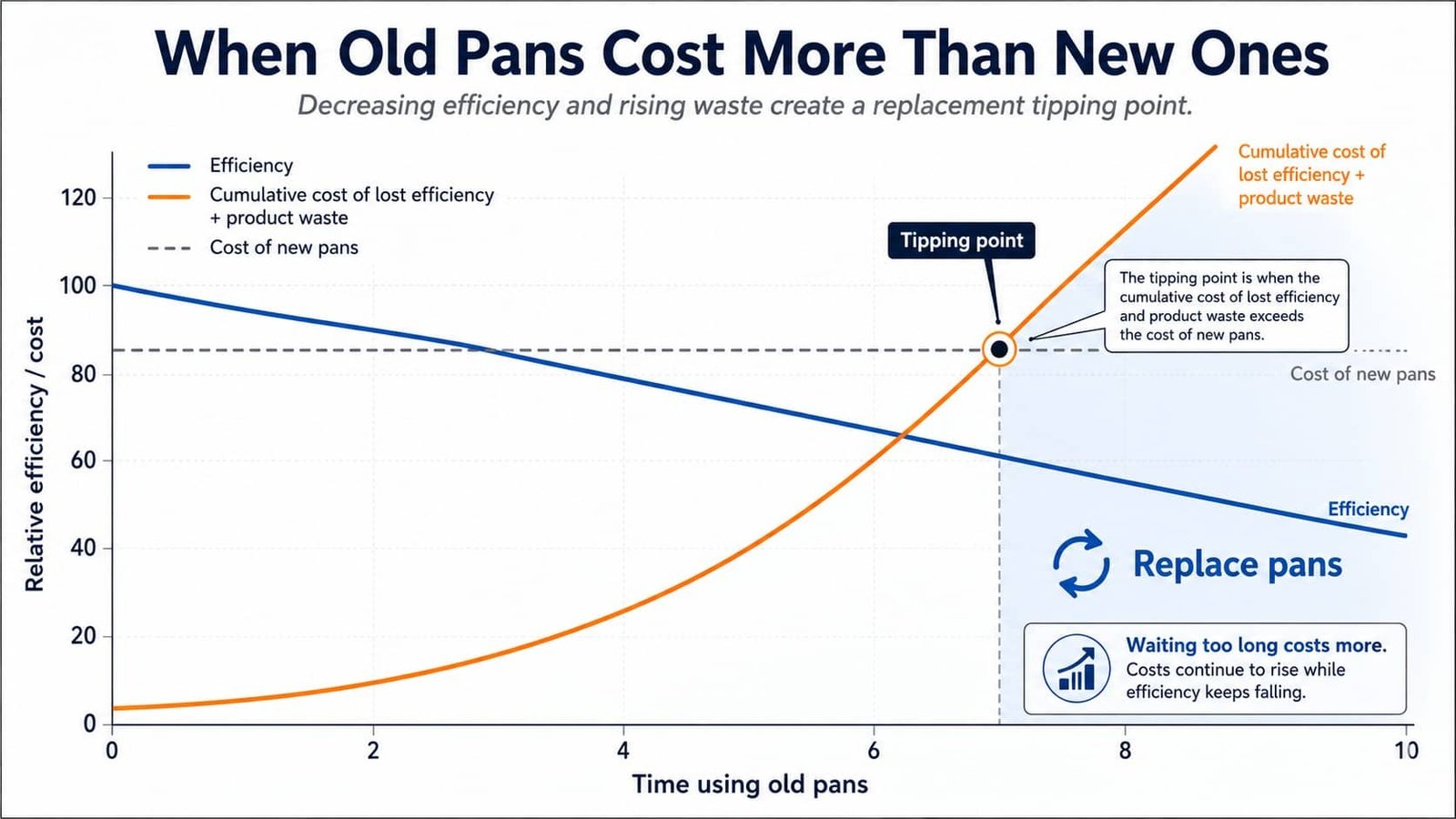
This is the most important question for any bakery manager. Unlike a home baker who might toss a pan at the first sign of a scratch, a commercial bakery must think in terms of return on investment. In all my years in this industry, I've learned that factories don't replace pans because they look bad. They replace them when the numbers prove it's the right financial decision. The pan has to truly hurt production efficiency or product quality before a change is made.
Calculating the Hidden Costs
To find this tipping point, you have to look beyond the price tag of new pans and calculate the hidden costs of keeping the old ones. Think about it: if your bakers spend an extra 30 seconds scraping out each pan, and you run 500 pans a day, that's over four hours of wasted labor every single day. If 5% of your product sticks and gets thrown away, calculate the cost of those raw materials. Suddenly, the "savings" from not buying new pans disappear.
This table helps illustrate the financial choice:
| Factor | Cost of Keeping Old Pans | Benefit of New Pans |
|---|---|---|
| Depanning Time | Extra labor costs per cycle | Instant release, reduced labor |
| Product Waste | 5-10% rejection rate from sticking | <1% rejection rate |
| Cleaning Time | Increased labor and chemical costs | Quick wipe-down, less water/time |
| Product Consistency | Uneven browning, customer complaints | Uniform, high-quality results |
When the costs in the first column add up to more than the investment in new pans, your decision is clear.
Conclusion
Replacing pans isn't about age; it's a strategic decision. When they harm your efficiency or product quality, it's time for a change to protect your bottom line.
"Top 5 Reasons for Downtime in Food Manufacturing - QUPAQ", https://qupaq.com/news/top-5-reasons-for-downtime-in-food-manufacturing/. Industry reports and academic studies on deferred maintenance in food manufacturing document that postponing replacement of critical production equipment increases product defects and line downtime, supporting the claim that delaying pan replacement can lead to ruined products and slower production; the magnitude varies by operation and equipment type. Evidence role: general_support; source type: research. Supports: Delaying could ruin products and slow production.. Scope note: Findings are often from case studies or broader equipment-maintenance literature and may not quantify impacts specifically for bakery pans. ↩
"Repair vs. Replacement Decision Making | www.waru.edu", https://www.waru.edu/acquipedia-article/repair-vs-replacement-decision-making. Guidance from food-processing and equipment‑management sources recommends using measurable production efficiency and product-quality metrics (e.g., defect rates, cycle times) as criteria for equipment replacement, supporting the article's rule that pans should be replaced when they harm efficiency or quality; such guidance is often generalized across equipment types rather than pan-specific. Evidence role: expert_consensus; source type: institution. Supports: Replace pans when they negatively impact production efficiency or product quality.. Scope note: Most guidance addresses equipment broadly rather than providing pan-specific thresholds. ↩
"Why Baking Sheets Warp in the Oven + How to Prevent It", https://www.nordicware.com/why-does-my-baking-sheet-warp/?srsltid=AfmBOophSwOwpQnnS7yfTCv0ak8R2s7lP1pMiYBSpVtsAoe7pJ1jSrhq. Food‑science and engineering literature describes how deformed bakeware alters heat transfer and can interfere with automated handling, supporting that severe warping causes uneven baking and can jam automation; specific thresholds for 'severe' warping depend on oven type and automation tolerances. Evidence role: mechanism; source type: paper. Supports: Severe warping causes uneven baking and can jam automated lines.. Scope note: Sources describe the mechanisms but rarely give a single numerical warping threshold applicable in all bakery settings. ↩
"Influence of heating temperature and time on mechanical ... - PMC", https://pmc.ncbi.nlm.nih.gov/articles/PMC11324993/. Food‑processing and occupational reports show that failure of nonstick coatings increases sticking and manual depanning time, which raises labor per unit; such sources support the link between coating failure and higher labor costs but typically do not provide universal cost figures. Evidence role: general_support; source type: education. Supports: Non-stick coating failure makes depanning harder and increases labor costs.. Scope note: Labor-cost impacts depend on production scale and local wages; studies often provide examples rather than universal metrics. ↩
"Modelling Volume Change and Deformation in Food Products ...", https://pmc.ncbi.nlm.nih.gov/articles/PMC8067021/. Heat‑transfer and food‑engineering publications document that uneven contact or warped cookware alters local heat flux, producing hot and cold spots that can overcook some areas while undercooking others, which supports the claim about uneven baking from warped pans; experimental conditions vary by oven and product. Evidence role: mechanism; source type: paper. Supports: Warped pans create hot/cold spots causing uneven baking (burnt and undercooked areas).. Scope note: Specific outcomes depend on product thermal properties and oven type; literature provides mechanism and case examples rather than a single rule. ↩
"An Evaluation System of Robotic End-Effectors for Food Handling", https://pmc.ncbi.nlm.nih.gov/articles/PMC10670141/. Technical specifications from industrial automation and robotic‑handling literature indicate that some automated food‑handling systems specify sub‑millimetre placement and dimensional tolerances for trays and pans to ensure reliable gripping and feeding; applicability depends on the specific robotics and end‑effector design. Evidence role: statistic; source type: research. Supports: Some automated systems require pans with sub-millimetre tolerances for reliable operation.. Scope note: Tolerance requirements vary by manufacturer and system; not all lines require <1 mm accuracy. ↩
"Commercial Baking: A Guide to Scaling Your Bakery Business", https://www.escoffier.edu/blog/baking-pastry/the-art-of-scaling-a-bakery/. Operational‑efficiency analyses and foodservice management studies demonstrate that small per‑unit increases in handling time scale to large cumulative labor costs across high-volume production runs, supporting the arithmetic claim that an extra minute per pan can produce substantial labor waste; precise cost impact is site‑specific. Evidence role: statistic; source type: education. Supports: Small increases in per-unit depanning time scale to large cumulative labor costs in high-volume bakehouses.. Scope note: Examples show scalability but do not provide a universal dollar figure for all bakeries. ↩
"A Scooping-Binding Robotic Gripper for Handling Various Food ...", https://pmc.ncbi.nlm.nih.gov/articles/PMC8032991/. Automation vendors and robotics research describe how automated bakery and food‑handling lines depend on consistent tray dimensions and gripping features to ensure reliable pick‑and‑place operations, supporting the claim that new automated lines may require pans with specific dimensions and features; exact requirements vary by system. Evidence role: expert_consensus; source type: research. Supports: Automated food lines often require uniform pan dimensions and design features for reliable robotic gripping and handling.. Scope note: Vendor documentation and standards vary; requirements are specific to the automation hardware in use. ↩
"Perforated vs Solid Baking Pans: Which Delivers Better Results?", https://kkbake.com/perforated-vs-solid-baking-pans-which-delivers-better-results/. Food‑science and commercial baking resources indicate that impingement and high‑airflow ovens use perforated or mesh trays to increase convective heat and moisture removal at the product surface, which helps form a crisper crust; effectiveness depends on product formulation and oven settings. Evidence role: mechanism; source type: education. Supports: Perforated pans in high‑airflow/impingement ovens improve airflow and can promote crisper crusts for appropriate products.. Scope note: Beneficial effects are product‑ and oven‑dependent; not every product requires perforation. ↩
"Effects of temperature and time on the physical characteristics ... - PMC", https://pmc.ncbi.nlm.nih.gov/articles/PMC6801284/. Thermal physics and baking literature note that darker surfaces have higher absorptivity/emissivity and can change surface heat transfer, and baking industry sources discuss using darker pan finishes to affect browning and bake time; applicability depends on pan material, oven type, and product. Evidence role: mechanism; source type: paper. Supports: Darker pan surfaces generally have higher thermal absorptivity and can influence heating and browning, which some bakers use to reduce bake times in certain ovens.. Scope note: Color effects interact with material properties and oven type; 'perform best' is conditional rather than universal. ↩
"Major equipment life cycle cost analysis", https://dr.lib.iastate.edu/bitstreams/9cc741a3-8603-4628-8890-d1ae29f0bded/download. Lifecycle‑cost and equipment‑replacement guidance from business and foodservice management sources recommend replacing equipment when cumulative operating and failure costs exceed replacement cost, supporting this economic tipping‑point formulation; practical application requires site‑specific costing. Evidence role: historical_context; source type: education. Supports: Equipment should be replaced when cumulative operating inefficiencies and waste costs exceed the cost of replacement, per lifecycle and replacement-cost guidance.. Scope note: Guidance provides a decision framework but requires local cost data to apply in a given bakery. ↩