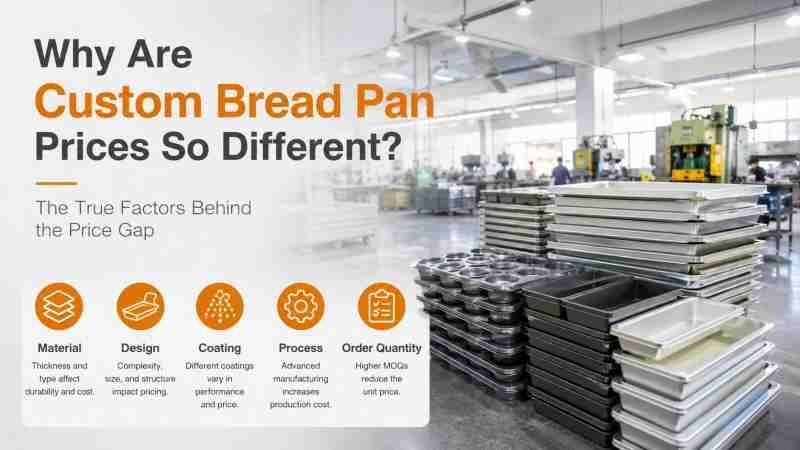
Confused by wildly different quotes for the same custom bread pan? Choosing wrong could shut down your production line. Let's uncover what those price tags really mean.
A price difference over 40% often signals a problem.1 The cheaper pan likely cuts corners on materials, coatings, and safety standards.2 The higher price reflects superior quality, proper certifications, and the capability to meet your exact specifications, protecting your business and your customers.
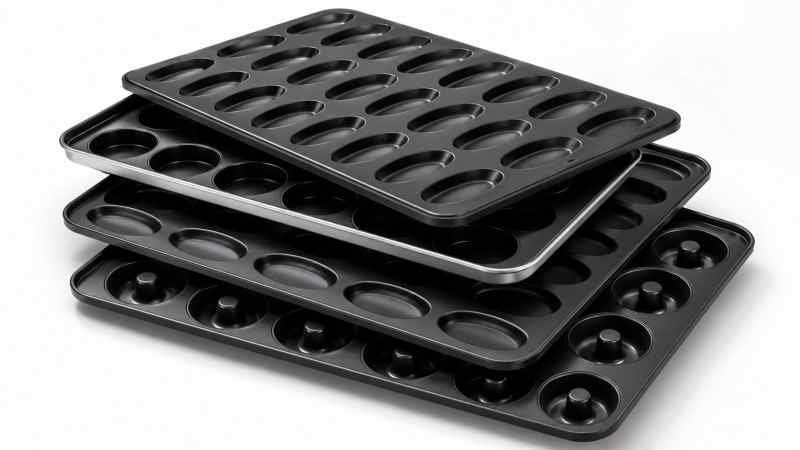
You’ve sent the same design drawing to three different factories, but the quotes you get back are worlds apart. It's tempting to just go with the lowest bidder, but in the world of industrial bakeware, that can be a costly mistake. Let's dig into why those numbers can be so deceiving.
What Hidden Dangers Lurk in a Cheaply Priced Pan?
That low price looks tempting, but it could hide serious risks. A failing pan can halt production, but a dangerous one can ruin your reputation.3 Let's look closer.
The biggest danger is the non-stick coating. Low-cost factories might use inferior coatings that peel quickly and, worse, pose a food safety hazard.4 This risk isn't worth the initial savings, as it can lead to production shutdowns or even factory closure for non-compliance.
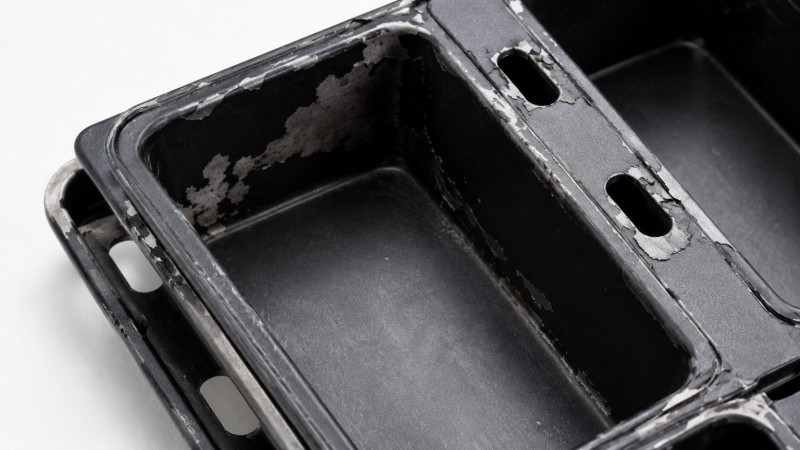
When you see a price that's dramatically lower than others, you have to ask where the savings are coming from. In today's manufacturing world, the processes for making bakeware are quite mature, so huge differences in efficiency are unlikely.5 The savings are often found by using cheaper, substandard materials. The most critical component here is the non-stick coating. A reputable supplier uses certified, food-safe coatings designed to withstand thousands of baking cycles.6 A low-cost supplier might use an uncertified coating that breaks down quickly. This not only means you'll be replacing pans more often, but it also creates a massive food safety risk. If that coating flakes off into your product, you're facing a disaster. The cost of a product recall, a production line shutdown, or damage to your brand is infinitely higher than the few dollars you saved on a pan.7 It's a gamble that no serious bakery should ever take.
| Feature | Low-Cost Supplier | Reputable Supplier |
|---|---|---|
| Coating | Uncertified, low-grade material | Food-safe, certified (e.g., CQC) |
| Lifespan | May fail after a few hundred uses | Guaranteed for 3,000+ uses |
| Safety Risk | High (potential contamination) | Low (tested and verified) |
| Consequence | Production halts, brand damage | Consistent, reliable production |
Does a Higher Price Mean Better Craftsmanship and Customization?
Is that expensive quote just a big factory's overhead, or are you paying for something more? The answer often lies in the small details that make a huge difference.
Absolutely. A higher price often covers the cost of executing complex details precisely as specified in your drawings. Small features, like reinforced edges or specific corner radii, can require advanced techniques and skilled labor, which cheaper suppliers might ignore or be unable to produce.8
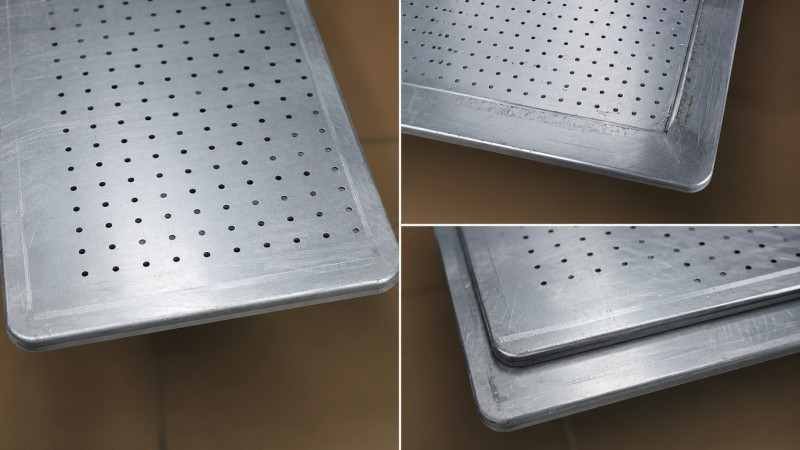
I saw this firsthand just a month and a half ago. We were working on a large, complex order for a U.S. client worth nearly $130,000. The customer sent us a sample of a pan they were using, and one specific detail caused our design team a lot of headaches: the rounded corners. Our initial design involved folding the pan's edges inward to form a strong, square tube frame. This process makes creating a smooth, rounded corner extremely difficult. To replicate the customer's sample, we had to completely rethink our process. After a lot of work, we found a solution, but it added at least $2 to the cost of every single pan. A cheaper factory might have just ignored that detail or told the client it wasn't possible.9 This experience shows that for custom, non-standard items like baking pans, small details can have a huge impact on cost. That higher price you're quoted often includes the engineering and labor needed to get those details exactly right. When a price is too low, you have to question if the supplier can even deliver what you've asked for.
How Do Factory Scale and Certifications Impact the Price?
You see a 30% price difference and wonder why. The factory's size, its testing reports, and its commitment to quality all play a major role in that final number.
Larger, more established factories have higher overheads. They invest in R&D, comprehensive testing (like ISO9001 and CQC food contact certs), and quality control.10 These costs are built into the price, but they also provide you with a guarantee of quality, consistency, and safety.
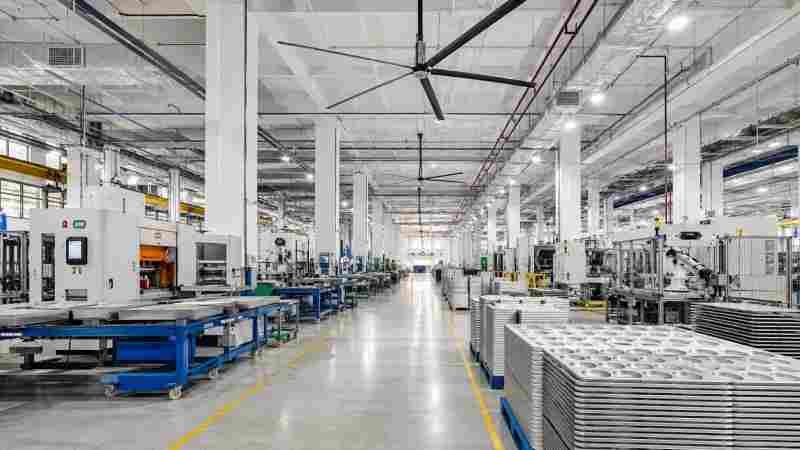
Think of it this way: when you partner with a large, professional factory, you're buying more than just a piece of metal. You're buying peace of mind. Our factory, for example, has a large design and development team, hundreds of pieces of advanced equipment, and a quality management system based on ISO9001 standards. Our products have passed CQC national food contact certification. All of this costs money. These investments ensure that customers like Klaus in Germany, who needs pans to fit his automated lines perfectly, or Chef Ahmed in Dubai, who needs extreme durability, get exactly what they pay for. On the other hand, a small workshop has very low overhead. They don't have an R&D department or a wall full of certifications.11 They can offer a low price because they are not providing the same level of assurance. They might miss important details in the drawings to save time, and they won't have the paperwork to prove their materials are safe.
| Factor | Large, Certified Factory | Small Workshop |
|---|---|---|
| Overhead | High (R&D, QC, Sales) | Low (Minimal staff) |
| Certifications | Yes (ISO9001, CQC, etc.) | No |
| Attention to Detail | High (Follows drawings exactly) | Low (May cut corners) |
| Ideal Customer | Industrial plants, large chains | Small, local bakeries with low budgets |
Conclusion
When buying custom pans, a huge price gap isn't a bargain; it's a warning. Choose the partner who guarantees safety, quality, and precision for your business's long-term success.
"[PDF] Abnormally Low Abnormally Low Bids and Proposals", https://thedocs.worldbank.org/en/doc/780841478724671583-0290022017/original/ProcurementGuidanceidentificationandtreatmentofAbnormallyLowBidsandProposals.pdf. Government and public procurement guidance characterizes bids that are substantially lower than the competition as 'abnormally low' and recommends additional checks to verify whether unusually low pricing reflects unrealistic assumptions or non-compliance; such guidance does not mandate a single universal percentage threshold (e.g., 40%) but treats large deviations as a risk indicator. Evidence role: expert_consensus; source type: government. Supports: A price difference over 40% often signals a problem.. Scope note: Guidance frames large deviations as a warning but does not define a single numeric cutoff applicable to every sector or market. ↩
"[PDF] Unsafe and Unregulated Chinese Consumer Goods: Challenges in ...", https://www.uscc.gov/sites/default/files/2024-11/Chapter_4--Unsafe_and_Unregulated_Chinese_Consumer_Goods.pdf. Studies and regulatory reports on imported consumer goods and manufacturing quality show that lower-priced products are more likely to be non-compliant with material or safety standards, illustrating a documented association between very low prices and higher rates of material or safety non-conformity. Evidence role: statistic; source type: research. Supports: The cheaper pan likely cuts corners on materials, coatings, and safety standards.. Scope note: Association documented in regulatory compliance studies does not prove every low-priced product cuts corners; results vary by region, product, and supplier. ↩
"Food Safety Trust, Risk Perception, and Consumers' Response to ...", https://pmc.ncbi.nlm.nih.gov/articles/PMC7068368/. Published case studies and food-industry analyses document that contaminated or unsafe equipment and products can force production stoppages, recalls, and measurable reputational harm to brands; such work supports the link between equipment failure/contamination and business disruption. Evidence role: case_reference; source type: paper. Supports: A failing pan can halt production, but a dangerous one can ruin your reputation.. Scope note: Most references discuss product recalls/contamination broadly rather than bakeware-pan failures specifically. ↩
"FDA Issues Warning About Imported Cookware That May Leach Lead", https://www.fda.gov/food/alerts-advisories-safety-information/fda-issues-warning-about-imported-cookware-may-leach-lead-august-2025. Regulatory agencies and toxicology reviews indicate that degraded or flaking coatings (including some non‑stick coatings and PFAS-containing finishes) can lead to contamination of food and raise food-safety concerns; the specific risk depends on coating chemistry and condition. Evidence role: mechanism; source type: government. Supports: inferior coatings that peel quickly and, worse, pose a food safety hazard.. Scope note: Health risk varies by coating type (e.g., PTFE vs. other chemistries) and exposure level; not all flaking coatings carry the same hazard profile. ↩
"Coating Process - an overview | ScienceDirect Topics", https://www.sciencedirect.com/topics/materials-science/coating-process. Technical overviews and industry descriptions of bakeware and sheet‑metal fabrication describe established, mature manufacturing processes (stamping, drawing, hemming, coating) with incremental innovation rather than radically different process efficiencies, which supports the claim that huge efficiency gaps are less common than in less standardized sectors. Evidence role: historical_context; source type: education. Supports: the processes for making bakeware are quite mature, so huge differences in efficiency are unlikely.. Scope note: Maturity of processes does not preclude variations in labor cost, automation level, or local supply-chain advantages that can produce meaningful price differences. ↩
"Influence of heating temperature and time on mechanical ... - PMC", https://pmc.ncbi.nlm.nih.gov/articles/PMC11324993/. Standards bodies and coating manufacturers document durability test methods for food-contact nonstick coatings (including cycle/life testing) and certify coatings for food contact; such standards and test protocols can demonstrate coating longevity under defined conditions, though exact cycle counts depend on test parameters. Evidence role: definition; source type: institution. Supports: certified, food-safe coatings designed to withstand thousands of baking cycles.. Scope note: Specified 'thousands of baking cycles' depend on coating formulation and test conditions; not all certified coatings come with identical cycle-life guarantees. ↩
"The Real Cost of Unsafe Food: Illness, Recalls & Brand Damage", https://www.spectacularlabs.com/resources/real-cost-of-unsafe-food. Analyses of food‑product recalls and contamination incidents provide quantitative estimates of direct recall costs and document indirect costs such as lost sales and reputational harm, supporting the claim that recall/shutdown costs typically far exceed the purchase cost of small pieces of equipment. Evidence role: statistic; source type: paper. Supports: If that coating flakes off into your product, you're facing a disaster. The cost of a product recall, a production line shutdown, or damage to your brand is infinitely higher than the few dollars you saved on a pan.. Scope note: Cost figures vary widely by incident severity, company size, and market; the phrase 'infinitely higher' is rhetorical—studies show substantially higher costs but not an infinite multiplier. ↩
"Sheet Metal Bend Radius Best Practices (Updated for 2026) | ASM", https://www.approvedsheetmetal.com/blog/are-you-using-the-right-bend-radius-for-your-precision-sheet-metal-formed-part. Manufacturing engineering sources explain that features such as reinforced hems, tight corner radii, and precision forming increase tooling complexity and labor/skill requirements, thereby raising production costs; these trade-offs are documented in sheet‑metal fabrication guidance. Evidence role: mechanism; source type: education. Supports: Small features, like reinforced edges or specific corner radii, can require advanced techniques and skilled labor, which cheaper suppliers might ignore or be unable to produce.. Scope note: The precise cost impact depends on material, tooling, and production volume; sources describe the mechanism but not a single price premium applicable to every design. ↩
"Pros & Cons of Contract Manufacturing: Is It Right for You?", https://www.owensdesign.com/custom-automation-design-engineering-manufacturing-blog/pros-and-cons-of-contract-manufacturing/. Manufacturing case studies and industry reports note that lower-cost suppliers sometimes limit offerings to simpler designs or decline complex custom features, reflecting trade-offs between price and capability; this supports the idea that some low-cost suppliers may not replicate intricate customer details. Evidence role: case_reference; source type: education. Supports: A cheaper factory might have just ignored that detail or told the client it wasn't possible.. Scope note: This is supported by anecdotal and case-study evidence rather than a universal rule; many small suppliers can handle complex work depending on specialization. ↩
"China Quality Certification Centre Co., Ltd. (CQC) - UNFCCC", https://unfccc.int/process-and-meetings/the-paris-agreement/paris-agreement-crediting-mechanism/a64-accreditation/china-quality-certification-centre-co-ltd-cqc. Descriptions from standards organizations and industry literature explain ISO 9001 as a quality management framework and identify national conformity assessment schemes (e.g., China CQC for certain product certifications) that require testing; firms invest in these systems to support consistent product quality and compliance. Evidence role: definition; source type: institution. Supports: They invest in R&D, comprehensive testing (like ISO9001 and CQC food contact certs), and quality control.. Scope note: Existence of standards and certification programs is documented, but holding these certifications varies by company and does not guarantee perfect performance in all cases. ↩
"Gross domestic spending on R&D", https://www.oecd.org/en/data/indicators/gross-domestic-spending-on-r-d.html. SME and manufacturing sector statistics from government and international bodies show that small workshops typically have lower overhead and lower R&D intensity than larger manufacturers, and are less likely to hold multiple formal certifications such as ISO 9001. Evidence role: statistic; source type: government. Supports: a small workshop has very low overhead. They don't have an R&D department or a wall full of certifications.. Scope note: Some small workshops may invest in niche certifications or R&D; the cited statistics describe tendencies across sectors rather than absolutes for every small workshop. ↩